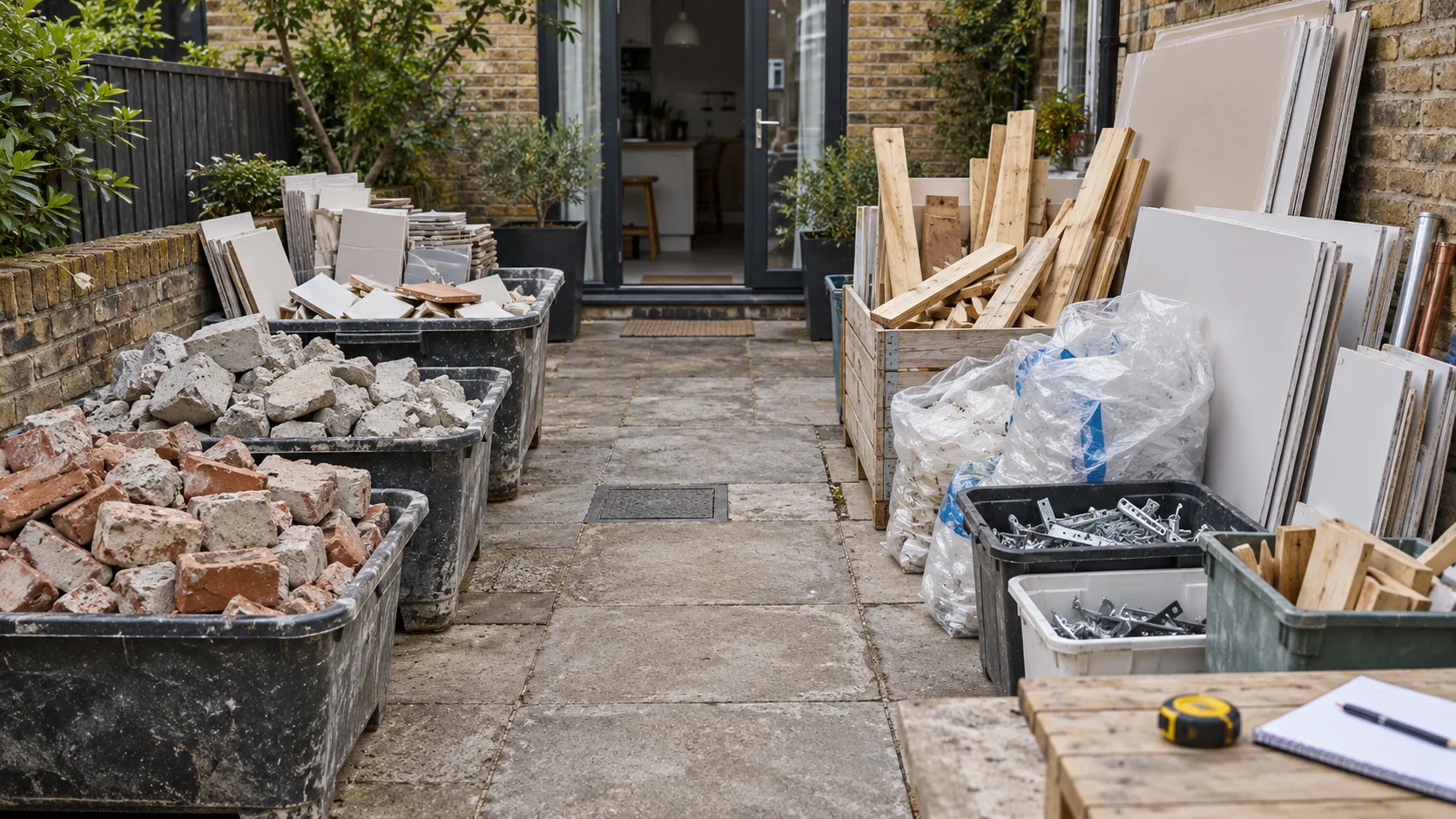
“Builders waste” is a useful everyday description, but it is too broad for an accurate collection plan. Ten bags of broken brick are a dense mineral load. Ten bags of timber scraps, plasterboard, insulation and packaging are a mixed load with different handling routes. A bathroom refit can produce both on the same day. The best first step is to identify what is actually in the pile, then count and photograph each material group before asking anyone to take it away.
This guide explains how to describe rubble versus mixed builders waste from a household project in London. It does not assign formal waste codes to a photograph or promise a price for a particular bag count. Businesses producing construction waste have their own classification duties; Environment Agency guidance sets out how they identify hazardous status and controls. For a collection quote, the homeowner can still make a much clearer inventory without pretending to perform a professional waste assessment.
Identify the mineral rubble before counting bags
Rubble commonly means concrete, brick, blocks, tiles, ceramics, stones and similar hard mineral fragments. The Environment Agency's construction waste table lists concrete, bricks, and tiles and ceramics as distinct streams, as well as a non-hazardous mixture of those materials where no hazardous substances are present. A supplier or collector may use “hardcore” for some of this material, but do not assume every hard-looking fragment has the same acceptance route. Describe the components in plain words.
Make a rough count of bricks or blocks where they remain whole. For fragments, estimate how many bags there are and how full each is. A bag filled to its rim with wet concrete is not equivalent to the same bag half filled with dry tiles. Measure a loose heap's approximate length, width and height, and photograph it next to a tape measure or familiar object. Give the collector the bag size if known. Our guide to photographing rubbish for a collection quote explains how an overview and detail view work together.
Keep clean mineral rubble apart from wood, insulation, plastic wrap, paint tins and ordinary rubbish. This makes the load easier to assess and may preserve a recovery route. If demolition has already mixed everything, do not describe the result as “clean rubble” because most visible pieces are brick. Tell the collector that it is mixed and show the inside and surface of the pile. You can sort obvious loose pieces when safe, but hidden material may still need professional assessment.
Not every renovation produces only one type of mineral material. Soil excavated for foundations or drains is another dense stream with its own origin and potential contamination questions. The soil and turf disposal guide explains measuring household garden soil, while a construction excavation may require different checks. Do not bury soil bags under concrete bags in the photograph or merge the quantities into a single number without saying what each contains.
List the other materials that make a load mixed
Walk through the work area and list timber studs, doors, skirting, plasterboard, insulation, metal pipe, cables, glass, plastic packaging, carpet, old sanitaryware and broken fittings separately. Not all of these need their own vehicle, but each changes the description. A pile of mixed timber and clean bricks has a different destination question from a pile of concrete and ceramic tiles. The waste provider should know the actual composition before committing to the job.
Plasterboard deserves explicit mention. It contains gypsum and North London Waste Authority says it must be separated from other waste. Our plasterboard separation guide explains how to keep sheets, offcuts and fragments identifiable. Do not quietly place it inside a rubble bag or assume that its white dusty surface makes it mineral hardcore. An ordinary mixed construction pile may need sorting before the receiving facility will accept it.
Wood also has more than one condition. Clean untreated offcuts, painted trim, damp chipboard and outdoor treated timber should not all be called “wood” without further detail. Show the coatings and attachments in close photographs. The old fence panel guide covers treated outdoor timber; inside a renovation, the collector still needs to know about paint, nails and large fittings. Pull loose screws into a rigid container where it is safe, but do not dismantle unstable structures merely to improve a waste photograph.
Paint and chemicals should not disappear in the “mixed” label either. Keep tins and liquids upright and separate, then check their specific route. Our leftover paint tin guide covers that question. Electrical items, batteries and fluorescent lamps also have distinct routes. If any material may contain asbestos, stop treating it as routine builders waste and obtain a competent assessment; Environment Agency classification guidance lists asbestos-containing construction materials separately as hazardous.
Avoid an unverified “non-hazardous” claim
A homeowner can describe visible materials, but appearance alone does not prove a waste is non-hazardous. The government classification guidance distinguishes ordinary concrete, bricks, tiles and ceramic mixtures from those containing hazardous substances. It also says that soil must be assessed before transfer and warns that asbestos fragments in soil change its classification. Do not tell a collector that a bag is “definitely clean inert rubble” when it came from an unknown demolition layer, a former industrial use or a surface with suspect coatings.
If the job involves an older building, identify unknown boards, pipe coverings, floor tiles or insulation before breaking them further. HSE's asbestos guidance is an official starting point for when to seek competent help. A normal collection company can then price only what it is authorised and prepared to carry. Do not mix suspect material into rubble to make it disappear from the scope. Isolation and accurate disclosure are more useful than a confident guess.
The same principle applies to liquid paint, solvents or adhesives spilled into a rubble pile. Tell the provider how the contamination happened and what material may be affected. It may need a different assessment or destination. A photograph of dry-looking bricks after the spill does not resolve the question. The purpose of the initial inventory is to find these exceptions while there is time to plan, not to make every load fit a simple label.
Measure volume, weight and access separately
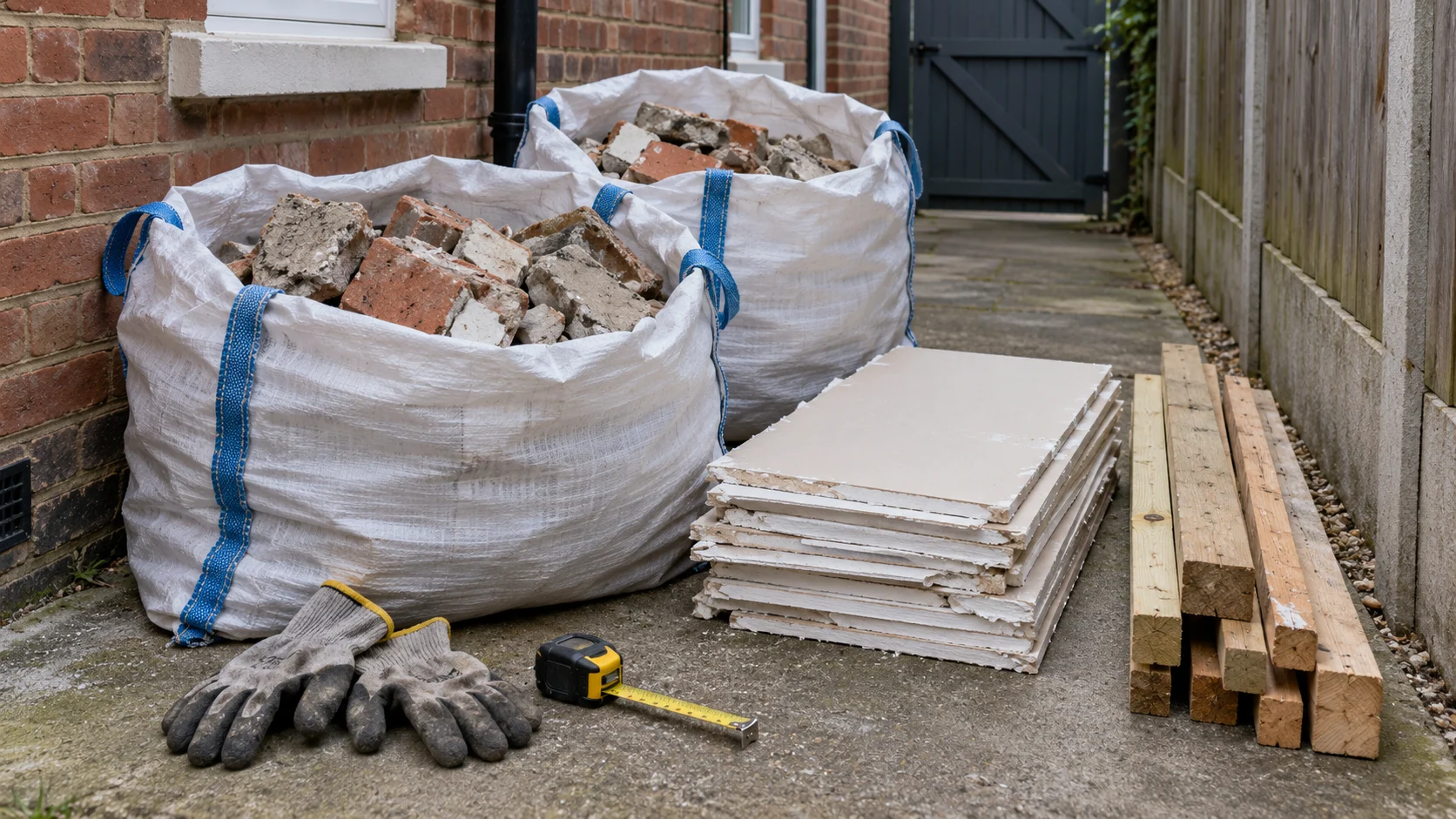
Rubble tends to be dense. A modest-looking number of bags can be the limiting part of a collection even when there is room in a van for much more bulky material. Do not fill bags to their visual capacity if they will be unsafe to lift. Ask the provider what bag type and fill level it accepts, and count the actual filled bags. Our heavy waste quote guide explains why a dense load cannot be priced from a wide-angle photo of its volume alone.
For loose boards and packaging, give rough dimensions or pile volume. Count bulky single items such as doors, baths or radiators separately. Make clear whether material is already in bags, stacked in a room, or still attached to a wall. A quote for pre-bagged material beside a parking space is different from a quote that includes dismantling, carrying down stairs and sorting. Ask exactly which labour is included rather than inferring it from the word “collection”.
Describe the route from the pile to the vehicle: floor, stairs or lift, doorway width, length of hallway, gate access, parking restrictions and distance. If there is no safe place to load at the property, say so before booking. The London parking and loading guide covers the practical access questions. Include photographs of the route, but do not move heavy bags into a public footway just to shorten a future carry.
If the work is ongoing, provide a first estimate and then an updated final count. Builders waste often grows after a hidden layer is removed. Tell the collector what is known, what may still be uncovered and when the final pile will be ready. A quote based on today's five rubble bags cannot reliably cover tomorrow's removed partition, insulation and plasterboard without a revised scope.
Match the material to a household or trade route
Some household centres accept small quantities of DIY rubble, but conditions are local. The North London Waste Authority's Haringey centre page, for example, states an allowance for qualifying household hardcore, rubble, soil and stones and requires bookings for vans or trailers. These are site-specific, current rules to check before visiting, not a citywide entitlement for every renovation load. A large project may exceed a minor DIY allowance even if it came from your own home.
The origin of the material matters. GOV.UK's household waste guidance includes DIY rubble, timber and bricks among household waste examples, but waste produced by a tradesperson during paid work is business waste. Agree with the contractor who is responsible for removal and documentation. Do not take a paid builder's waste to a residents-only centre and present it as your own small DIY project without checking the rules.
For a private collection, ask whether the company accepts the mineral, gypsum, timber and other streams listed; whether it will separate them; and which materials it excludes. Check the waste carrier's registration and keep the booking and handover details. GOV.UK says that a householder giving waste to someone else must make sure the person is legally allowed to take it. A registered carrier still needs a suitable destination for the actual composition you have declared.
Do not assume a skip or collection team is automatically best for every job. A clean small DIY load within a centre's allowance, a large business-generated load and a mixed household clearance are three different planning cases. Our skip versus collection guide helps compare logistics for a smaller project, while the builders clearance service is a starting point for a booked removal with a clear material list.
Send a concise inventory that can be checked on arrival
One practical message can prevent most misunderstandings: “Eight partly filled bags of brick and concrete, two stacks of plasterboard offcuts, one small pile of timber, one box of metal fixings; no paint or suspect asbestos identified; ground-floor rear garden, side-gate access, van parking 25 metres away.” Change the details to match your actual site. Attach a wide photo and close views of each group, and flag anything uncertain. Do not use the example as a declaration that an untested real load is free of hazardous material.
Ask the provider to confirm which groups are accepted, what sorting or bagging it expects, whether carrying and disposal are included, and how changes to the pile will be handled. The guide to what a rubbish removal quote should include gives a useful checklist. Before the crew arrives, compare the agreed inventory with the actual material. If a new board type or additional bags have appeared, send an update rather than waiting for the team to discover them at the gate.
After collection, check what remains and keep the receipt. A small pile of gypsum hidden behind a door or a few bags of rubble left due to weight should be recorded and given a route, not treated as the job being complete. The reliable distinction is not a clever label; it is a visible, measured inventory that makes the dense mineral component and every other material clear. That lets a council site or collection team decide how to handle the real load. To discuss your separated renovation waste, contact Rubbish Please with photographs and access details.