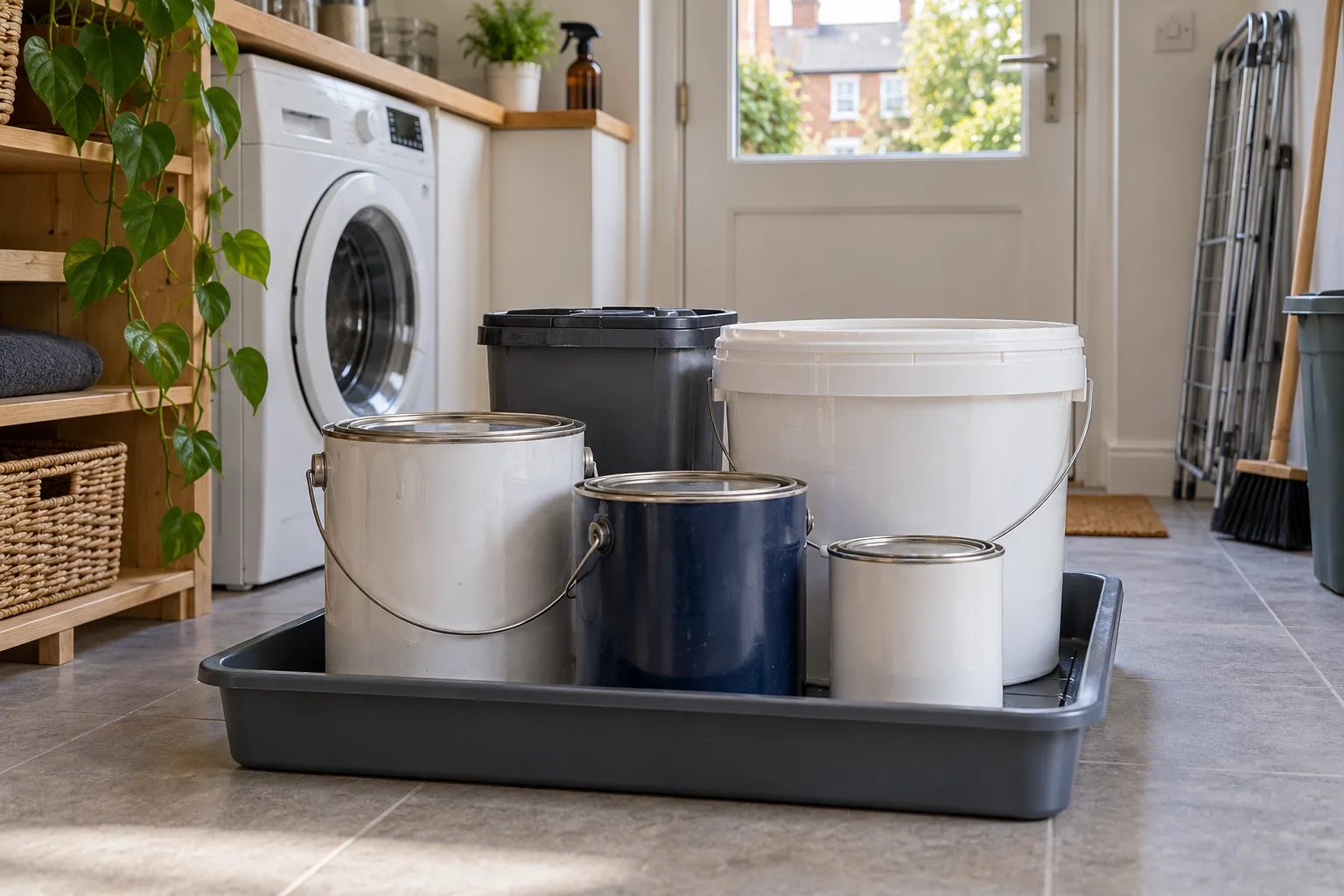
The last stage of decorating often leaves a cupboard of part-full paint tins. Some contain enough sound emulsion for touch-ups, some are empty, and others hold gloss, varnish or thinner that cannot follow the same route. When a property is being cleared, it is tempting to put the whole collection into the ordinary rubbish load. That creates a handling problem for the next person and may send liquid or hazardous material to a service that has not agreed to receive it.
The practical starting point is an inventory, not a disposal guess. Count the containers, read their original labels, estimate how much remains and check whether lids and sides are sound. Then separate usable paint for a confirmed recipient, empty dry packaging for a local container route, and remaining material that needs a council or specialist service. This guide concerns household decorating products in London. A business or contractor's paint waste may have different records and acceptance rules; tell the recipient where the waste came from.
Keep the containers upright while you assess them
Put the tins somewhere stable and away from children, pets and the route used by the clearance crew. Keep them in their original containers with lids fitted. A shallow tray or other suitable secondary containment can help if a lid or rim is suspect. Do not pour several unknown products into one tin, decant paint into an unlabelled drinks bottle or put a leaking tin inside an ordinary sack without telling the receiving service. The label is part of the information needed to choose a route.
Photograph each type of product and the whole group. Note metal cans, plastic tubs and any separate bottles of white spirit or thinner. Even if the containers look similar, water-based wall paint and solvent-based gloss need different decisions. If a label is unreadable, treat the material as unidentified and ask the council or specialist provider what details it needs. Do not open every old tin just to create a photograph of its contents.
Make a simple count by category: usable original containers, empty dry metal cans, empty plastic tubs, part-full water-based paint, solvent-based products and unidentified containers. Include approximate sizes and any damaged packaging. Our guide to photographing a rubbish load for a quote explains how overview and detail images work together. A photograph of ten closed tins without a count or product description is rarely enough for an accurate acceptance decision.
Offer usable paint only through an agreed reuse route
An original, sound container of usable paint may be useful for touch-ups, a neighbour or a local reuse scheme. Keep a small quantity with the property if the owner wants future maintenance and it can be stored appropriately. For surplus paint, ask a named recipient what it takes before moving the tins. A charity or community organisation may accept some products and reject others; it should not be left to discover unidentified paint at its door.
Community RePaint's guidance describes local schemes and states that its household reuse criteria include original containers, good condition and suitable non-hazardous paint. Check the current local drop-off point and any resident-access rules before travelling. The scheme's map is a starting point, not a guarantee that the nearest site accepts every product on a particular day. Keep the paint upright and closed during transport, following the receiving site's instructions.
Do not describe paint as donated until a recipient has accepted it. A partly used tin that has leaked, lost its label or gone off is not a good reuse candidate simply because it has not dried. If no reuse route is available within the clearance deadline, move it to the correct disposal question instead of placing it among furniture. The sorting guide before a house clearance uses the same principle: a reuse pile needs a real destination and handover date.
Distinguish water-based paint from solvent-based products
Read the product label rather than judging by colour or container shape. Water-based emulsion commonly used on walls is not the same as solvent-based gloss, varnish, white spirit or paint thinner. Do not mix them or assume that a dry-looking surface proves the whole tin is solid. Tell a local authority or collection provider which products are present and how much liquid is left. If a tin is unidentified, use the more cautious enquiry route until it can be classified.
North London Waste Authority's paint guidance gives separate instructions for reusable paint, water-based emulsion and oil-based paint or varnish. In its area, reusable paint can go to participating reuse and recycling centres, water-based emulsion has specified centre or fully dried-out routes, and oil-based paint is directed to a hazardous-waste service rather than the normal rubbish bin. These details apply to that authority's service and may change; check the current instructions for the property postcode before acting.
Recycle Now also distinguishes solvent-based paint, thinner and white spirit as hazardous-waste items. Do not attempt to dry out or dilute an unidentified or solvent-based product merely to make it look acceptable to an ordinary collector. Do not pour leftover paint or solvent into a drain or onto the ground. If a product is leaking or its container is unsafe, keep people clear and ask the receiving service for specific containment and handover advice rather than improvising a transfer into another vessel.
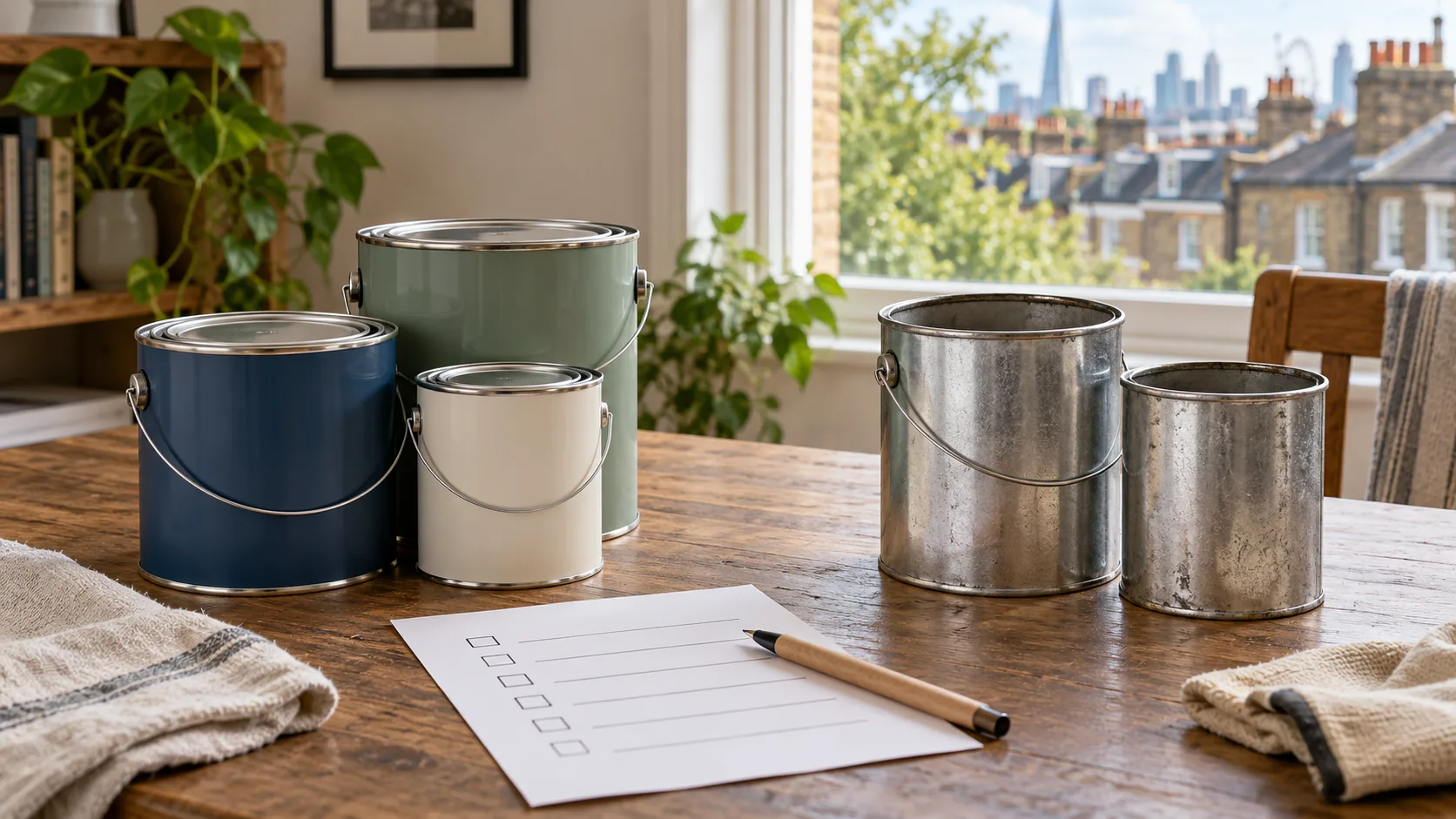
Treat empty packaging as a separate question
An empty, dry metal paint tin is different from a tin containing liquid paint. Recycle Now says empty or dry metal paint cans are accepted at many recycling centres, subject to local authority rules. It also notes that plastic paint containers are not widely accepted at those centres. North London Waste Authority lists empty metal paint tins for its centre recycling route but directs empty plastic paint containers to general waste in its area. This does not authorise putting every container in a kerbside recycling bin.
Check the material, whether it is genuinely empty and the specific site or council instruction. A skin on top of liquid paint is not an empty container. If a local authority permits fully dried water-based residue in normal rubbish, follow its method and verify that the contents are solid throughout before using that route. Do not generalise that method to gloss, solvent, varnish or unidentified products. The receiving service's rules determine whether the container and its contents should stay together.
Keep brushes, rollers, rags, trays and thinner bottles out of the “empty tin” count. They may need separate acceptance decisions, especially if soaked in solvent. A paint clearance list that says “six empty tins” should not conceal a bag of wet rollers and a litre of white spirit. Describe accessory waste in the same way that our guide to a complete rubbish-removal quote recommends describing every material that could alter the work.
Confirm the local or specialist collection before booking
Use the council's current website or its recycling centre information for the exact postcode. Ask whether householders can take usable paint, dried emulsion, empty containers or hazardous products; note any booking, residency and vehicle rules. GOV.UK has a local hazardous-waste service finder for England and Wales, which is useful when the borough's ordinary centre does not accept a product. Tell the service about any thinner, varnish or unknown contents before travelling.
Do not assume that a general house-clearance team will take liquid paint. If paint tins are among the contents of a property, separate them from the ordinary load and ask the provider explicitly whether it has an appropriate route for each category. The Rubbish Please house-clearance page can start a discussion about the rest of the property, but it is not a promise that every paint or hazardous item is accepted. Get the exclusions and any specialist arrangement in writing before the collection day.
If using a private waste carrier for an accepted stream, GOV.UK says a householder should check the business is authorised to carry waste. A carrier's registration does not by itself prove that a particular vehicle or destination accepts solvent-based paint, so ask about the material-specific route as well. Keep the booking details and any handover confirmation with the property inventory. For a contractor-generated load, agree disposal responsibilities with the contractor before it leaves site.
Finish with a counted handover
Before the property is signed off, compare the final tins with the inventory. Keep a note of which usable containers stayed with the property, which went to a confirmed reuse recipient, which empty packaging went to an accepted local route, and which products were handed to a hazardous-waste service. If a provider declined an item, leave it in a safe identified place and arrange its next route rather than putting it back into an unmarked mixed pile.
The useful question for each tin is simple: what product is it, how much remains, and who has agreed to receive it? When you request an estimate for the ordinary clearance, share the paint inventory and photographs so exclusions are clear. A small amount of careful sorting prevents one overlooked liquid container from holding up the whole job or being sent to the wrong stream.