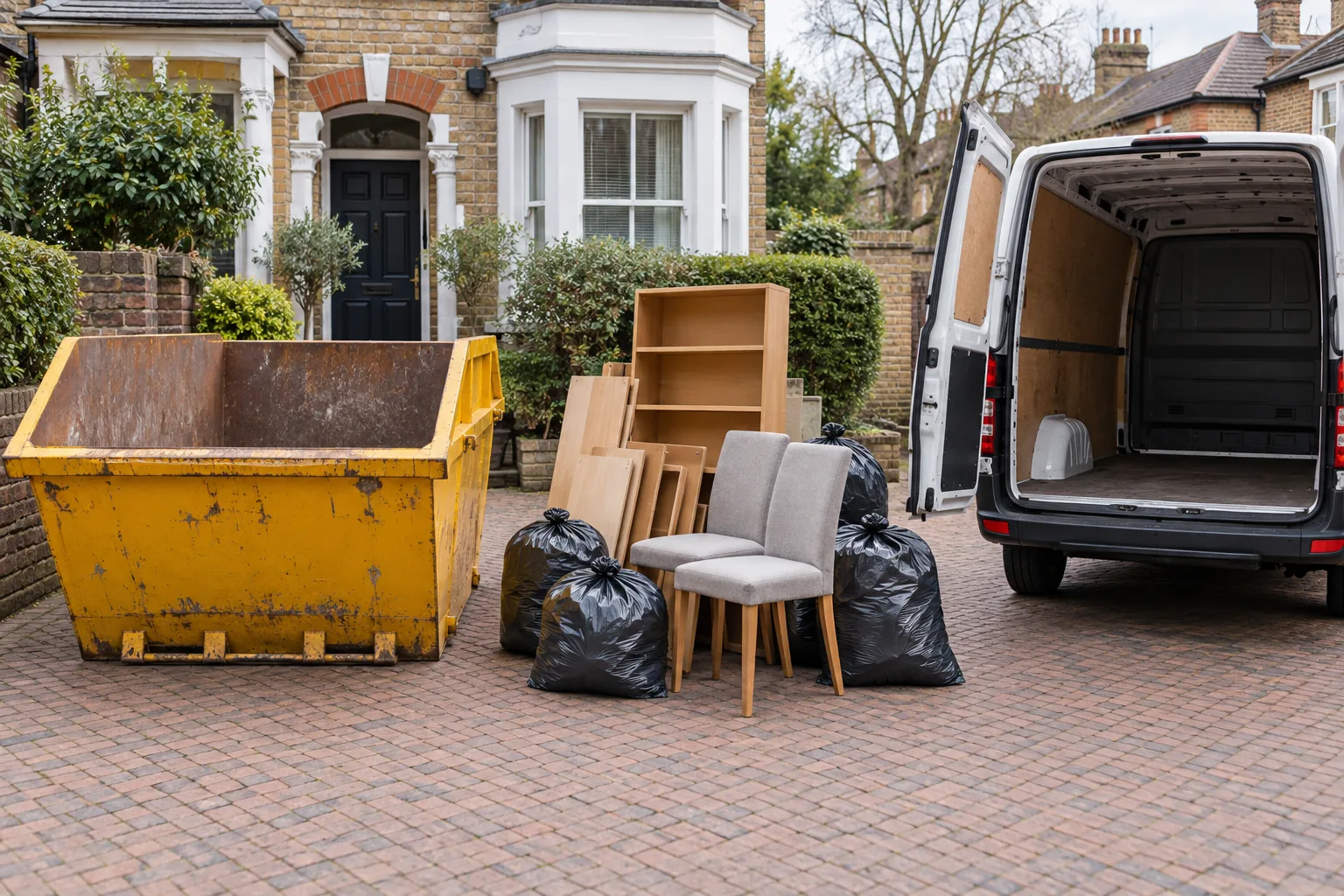
A small clear-out can be awkward to plan. You might have a broken bookcase, a few bags from a cupboard and a carpet offcut. The pile is too much for your usual bin, but it may feel too little for a large container. Should you hire a skip and load it yourself, or ask a collection team to take the material? The right answer depends less on a headline price than on where the waste is, how long you need to fill it, and what work you can do safely.
A skip gives you a container for a set period, subject to the hire terms and the space available. A collection team comes for an appointment and can usually discuss carrying and loading as part of the job. Neither choice is universally cheaper or simpler. This guide walks through the decision for a compact household job and shows what to include when requesting comparable quotes.
Define the small job before choosing a service
Begin with a short item list. Count bags and boxes, identify bulky pieces, and note any heavy or unusual material. A compact pile of cardboard, clothes and light furniture behaves differently from the same-sized pile of tiles or soil. Measure a large item if it may not fit through a doorway or into the chosen container. Take a wide photograph that shows the entire load and a second view of anything hidden behind furniture.
Be clear about where the material sits. Is everything already in a ground-floor garage, or must someone carry it down stairs? Will a move or renovation produce more items over the next week? Can you separate usable belongings for donation first? A rough “small load” label does not answer those questions. The Rubbish Please price guide can help you picture indicative load sizes, but ask for an estimate based on your actual list, materials and access.
Keep uncertain items out of the final count until you have decided whether they are leaving. If a tenant or family member still needs to check possessions, do that before you book. This avoids paying for a container that is too large or discovering that a timed collection cannot take a second pile that appeared after the quote. For a genuinely small load, a few minutes spent defining scope can save more effort than comparing vague starting prices.
When a skip may fit the way you work
A skip can suit a clear-out that unfolds over several days. You can load it in stages as you empty a shed, dismantle shelves or finish a room. That flexibility is useful when you do not yet know precisely which day the final items will be ready. It also lets you control the order of loading. Ask the hire company what size is suitable for your described material, the hire duration, what it can accept and what happens if the container is overloaded.
The trade-off is that you normally need to put material in the skip yourself unless you separately arrange labour. Even a small amount can involve repeated carrying from an upstairs flat to the vehicle area. Consider the weight of bags, the route through shared space and your ability to lift safely. Do not pile waste above the skip's permitted level or assume a heavy material can be added without checking the hire terms. A skip that looks partly empty may still be unsuitable if the contents are too dense.
You also need a viable position for the container. An entirely private driveway may work if there is room for delivery and collection and the property owner agrees. Check the dimensions and access needed by the hire company. A narrow entrance, overhead branches, parked cars or a shared drive can make placement more difficult than the size of the waste pile suggests. Do not book until the operator confirms the proposed location is practical.
Check public-road permission before booking a skip
If the skip would stand on a public road in England or Wales, GOV.UK says a skip licence or permit is needed. In most areas the skip company applies, while in some areas you may need to do it yourself. Your local council sets the detailed rules. GOV.UK also says a skip cannot be placed on the pavement. If it sits entirely on private land, the public-road skip licence is not required, though you still need the relevant property permission and safe access.
Ask the hire company who obtains any permit, when it must be approved and whether the quoted amount includes that cost. A controlled parking area may have separate restrictions; confirm the exact requirements with the council and operator for your location. Some sites need lights or markings around a skip. Do not treat a free parking bay as permission to leave a container there for days.
This is often decisive for a small London clear-out. If you have no private space and the road location is difficult, a timed collection may be easier to arrange. It still needs a legal loading point and a workable route, but the vehicle usually remains only for the collection rather than occupying a place for the hire period. Describe parking restrictions to either provider before accepting a quote.
When a collection team may fit better
A collection team can suit a load that is already identified and ready to go. You agree an appointment, explain where the items sit, and ask whether the team will carry, load and take them away. This can be useful when you cannot safely lift furniture, have no space to keep a skip, or need the area clear at one agreed time. Check the team's exact scope: some estimates assume items are outside, while others include carrying from inside a room.
The main constraint is that the description must be reasonably complete before the visit. If you add several heavy bags after booking or a second room becomes part of the job, the amount of labour and vehicle space may change. Send updated photos and ask for a revised estimate before the crew arrives. Our guide on what a rubbish removal quote should include sets out the load, labour, access, disposal and change conditions to compare.
State the stairs, lift, narrow turns, distance to the vehicle and any time restriction on the property. A sofa upstairs and a sofa at the front door are different jobs. If a team will dismantle something, ask whether that is included. If you need sweeping or bagging, ask specifically rather than assuming it is standard. A useful collection price reflects the service you will actually receive, not only the amount that fits in a van.
Compare the full cost and your own work
Ask a skip provider for the container size, hire period, accepted materials, delivery and collection, permit arrangements and charges for overfilling or extra time. Ask a collection provider for its included load, people and carrying work, number of visits, disposal and conditions for a changed load. Then add the work you must do yourself. A lower invoice can be less attractive if it leaves you carrying dense items down four flights of stairs.
Do not compare one provider's smallest advertised price with another's price for a fully described job. Give both the same item list and location details. If you can load safely and need several days, the skip's flexibility may be worth paying for. If the pile is settled, the site has no container space and you want the crew to carry it, a collection quote may match the job better. You may also find that council collection or a local recycling centre is suitable for one or two specific items; check your council's accepted materials, booking rules and charges.
The waste type matters as much as quantity. Check whether either service accepts mattresses, electrical items, plasterboard, paint, batteries or other distinct materials. Do not hide excluded items in ordinary bags. GOV.UK's household waste guidance says to check that a private company taking your household waste is on the register of waste carriers. That applies when comparing a skip company and a clearance service alike.
Work through three common small-clear-out situations
For a single-day flat clear-out, imagine one bookcase, two chairs and eight light bags, all ready now. There is no driveway and the flat is on the third floor. A collection team that confirms carrying from the flat may be a practical match. A skip would need a lawful location and you would still need to move everything down. Ask for the crew's scope in writing and show the stair route in your photos.
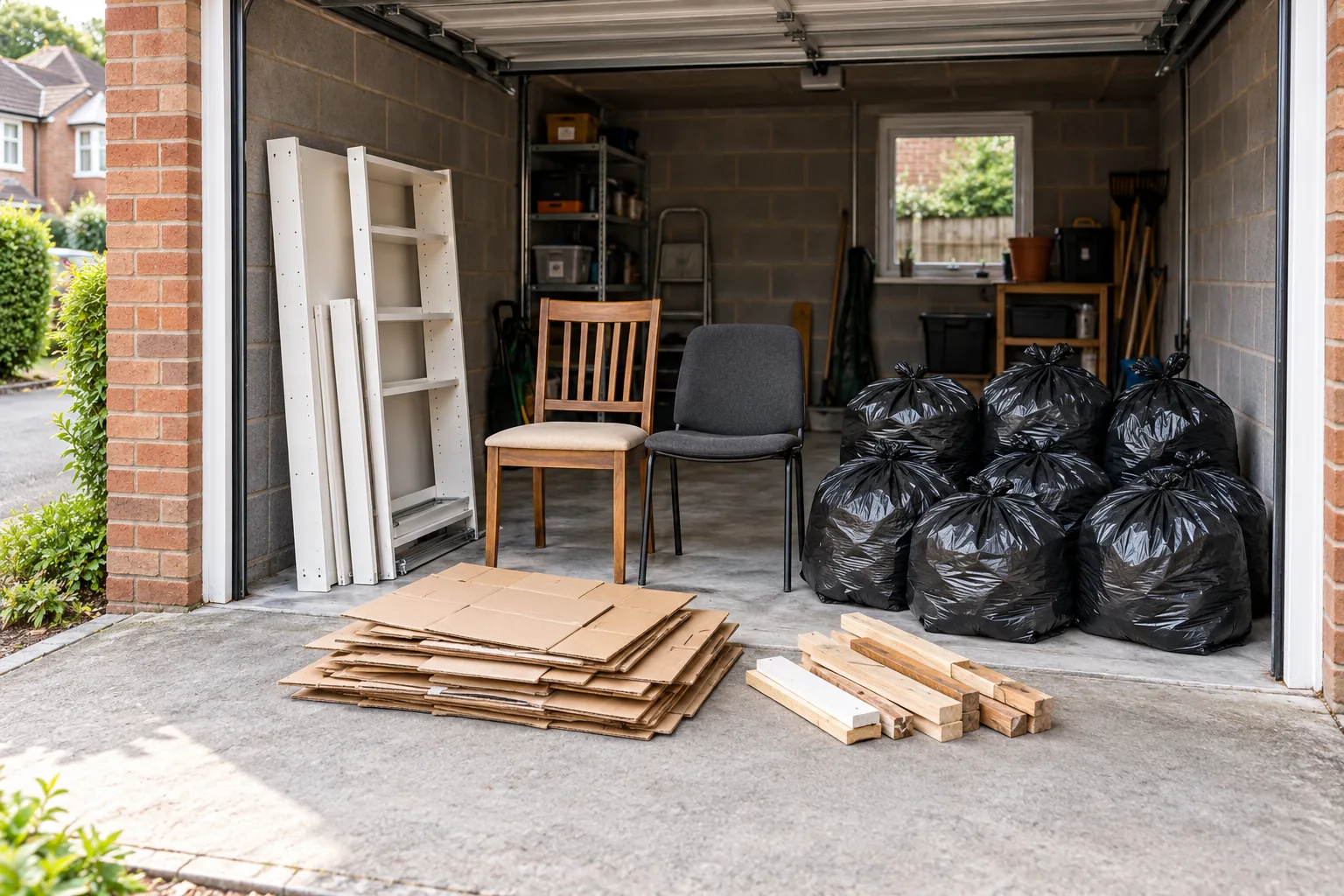
For a garage tidy that will continue over a week, imagine boxes, timber offcuts and old shelving on a private drive with adequate delivery access. A suitable skip may let you load as you sort, provided the hire company accepts the materials and confirms the placement. If heavy items emerge, update the operator before loading them. A timed collection might be better once everything is in a final pile, but booking too early risks an incomplete estimate.
For a small renovation pile, imagine six bags of broken tiles, timber and packaging. The volume looks modest, but the tiles are dense. Neither a tiny skip nor a “quarter van” label alone proves that the load is suitable. Describe each material and the bag count, ask about weight limits and separation, and confirm who will lift the bags. Our article on heavy waste and van-load quotes explains why this question matters before you compare totals.
Make the choice with a clear brief
Write down the items, material types, location, access route, desired date and whether you can load safely. Ask the skip operator about placement, permit responsibility, duration, accepted waste and any weight or fill restrictions. Ask the collection team about carrying, loading, disposal, vehicle limits and what happens if the load changes. Keep the written response that matches your photos and list.
If you have a compact load ready for an arranged visit, contact Rubbish Please with the details for a waste removal estimate. If you need the flexibility of filling a container over time, get a skip quote with the placement and permit details settled first. The best route is the one that handles the actual waste, access and labour safely at a price whose scope you understand.