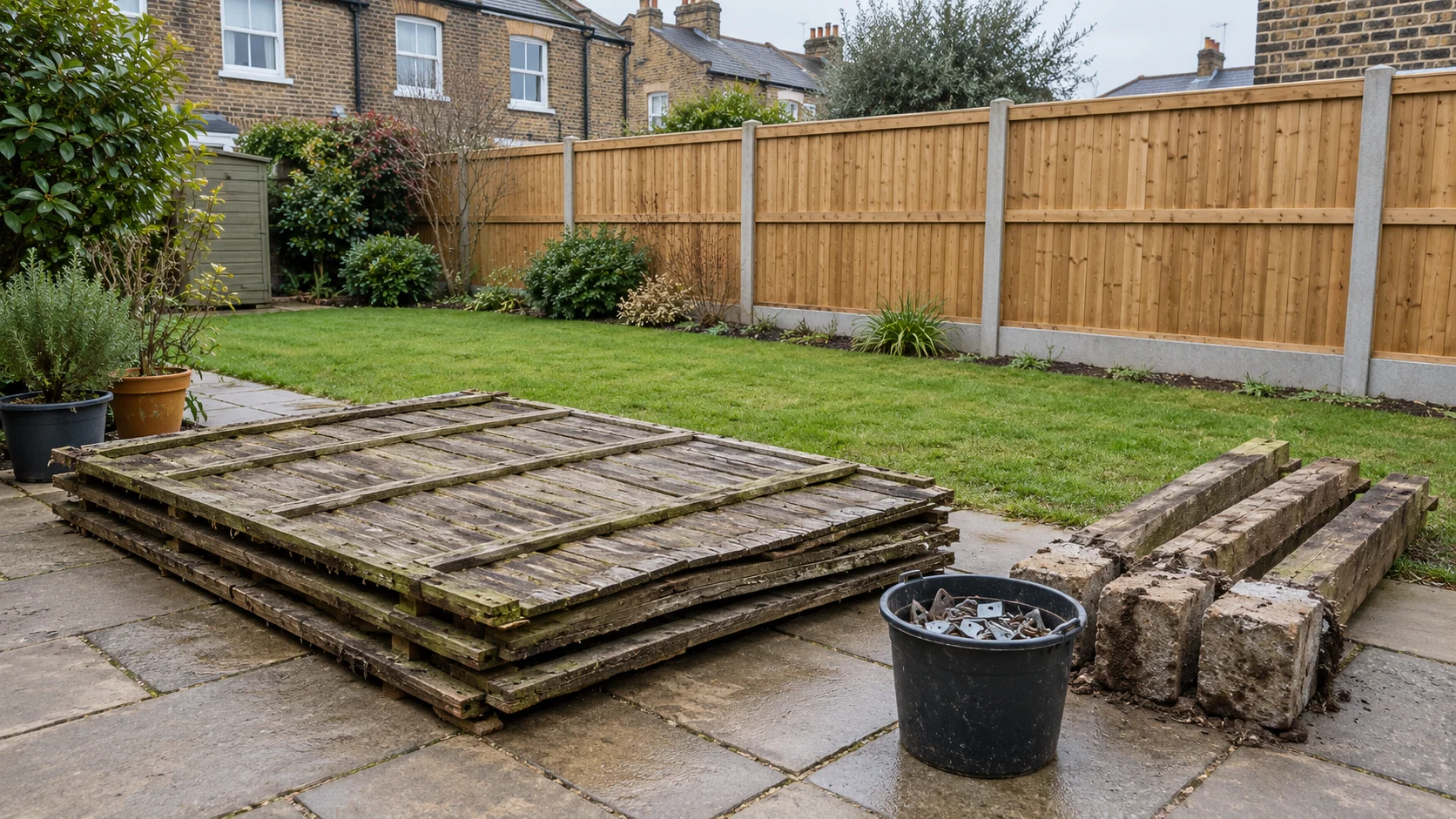
Replacing a fence can leave a surprisingly awkward pile. A panel that looked light when it stood upright may be wet, bowed and difficult to carry through a side passage. Several panels, posts set in concrete, loose slats and a bucket of screws are also different materials, even though they came from one project. The easiest way to arrange old fence panel disposal is to count and sort the pieces before asking for a quote or loading a vehicle.
This guide is for household garden fencing after repair or replacement. It explains how to identify panels worth keeping, what to tell a collector about treated timber and how to check the local recycling centre route. For the wider clearance after an outdoor project, see our mixed garden debris guide. If the job includes dismantling a whole structure, ask whether that work is included before booking a garden clearance.
Count the panels, posts and attachments separately
Start with an inventory rather than a single description such as “one old fence”. Count full panels and measure their approximate height and width. A standard-looking panel may still be too wide for a narrow gate or stair turn. Note whether panels are intact, split into sections or reduced to loose boards. Photograph the entire stack with one panel visible end to end, then take a second picture of the route to the vehicle. Our photo guide for a collection quote explains the views that help a team assess volume and access.
Count timber posts separately. A post with a heavy concrete footing is a mixed, dense item; it is not equivalent to a clean length of wood. Record any concrete spurs, gravel boards, metal post shoes, gates or wire mesh. If a contractor is replacing the fence, agree in advance who will remove the old material and whether that work is included in the installation price. Do not assume that the installer will take it simply because the panels are down at the end of the day.
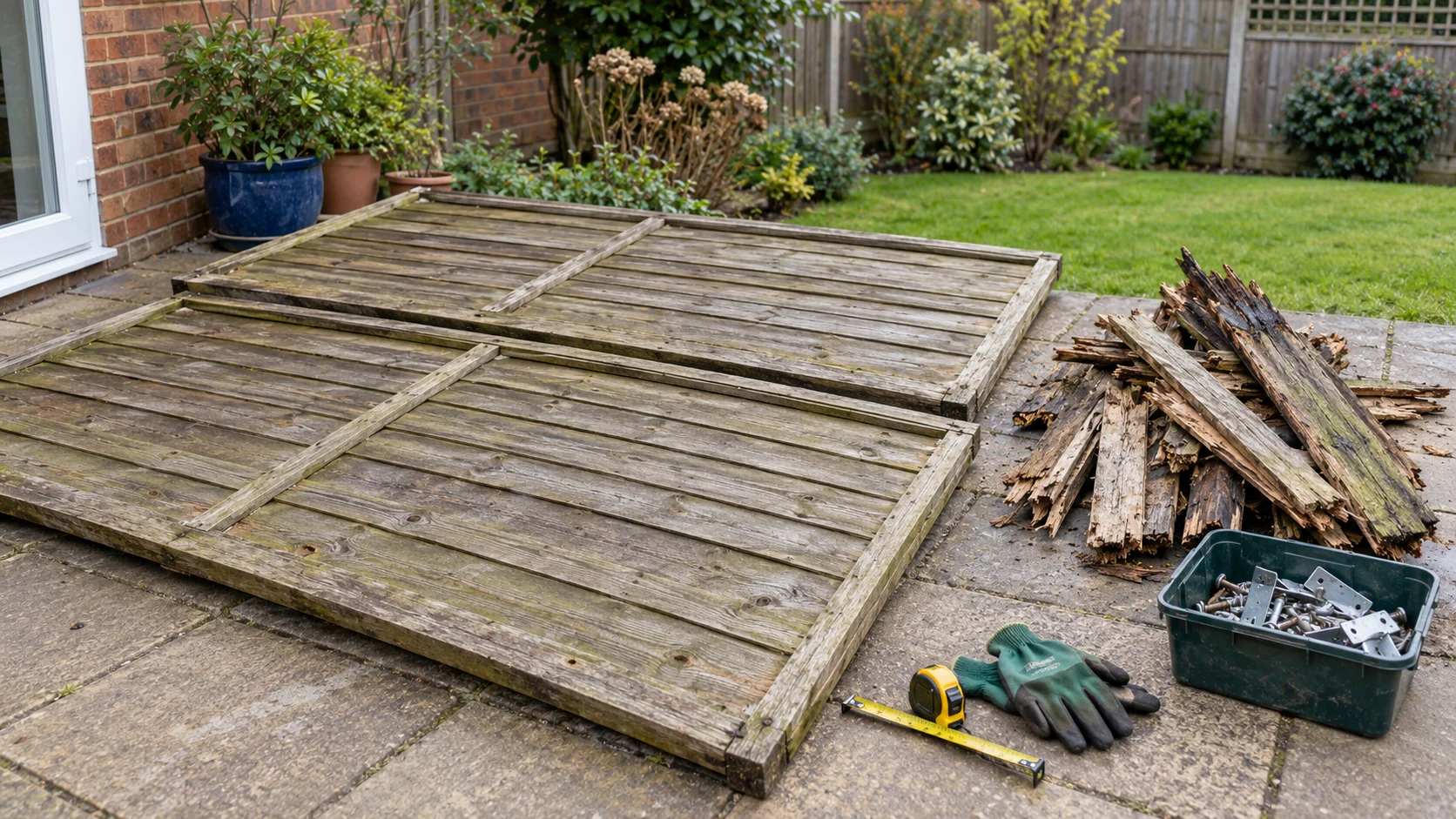
The condition of the load matters as much as the count. Mention wet, rotten or heavily painted wood, visible preservatives, old creosote-like coating, loose nails and broken glass if any is attached. Do not identify a treatment solely by colour; a faded brown board cannot tell you exactly which preservative was used. Where the treatment is unknown, say so. This gives the receiving site or licensed collector the chance to direct the material to an appropriate stream.
Save panels only when reuse is realistic
An intact panel may be useful for a short repair, a matching boundary, an allotment project or a neighbour who needs the same style. Check the frame, rails and slats by eye before offering it. A panel with severe rot, widespread splitting or an unstable frame is unlikely to be a good reuse candidate. A small repairable defect is different from a panel that falls apart when lifted. Keep any truly reusable pieces dry and supported flat until the handover; leaning them unsecured against a public wall creates a separate hazard.
Measure the reusable panel accurately, including thickness and any unusual fittings. If you list it for collection, state whether the person must bring a suitable vehicle and how soon it needs to go. Confirm the handover before removing it from the clearance quote. Otherwise a promised collection that never happens can leave the garden blocked on the day the rest of the waste is removed. For a large panel, two people may be needed to lift and carry it safely.
Some attractive small offcuts can be reused for non-structural projects, but unknown treated wood should not be casually turned into raised-bed sides, animal housing or fuel. The intended use, condition and treatment all matter. A new fence may also leave spare *new* material, which is easier to identify and pass on than decades-old boards. Keep the new offcuts separate so a collector does not treat them as part of the old waste pile by mistake.
The choice to repair instead of replace can reduce waste where only a few slats or fixings have failed. That decision should be made before the fence is dismantled and after checking whether the posts and rails are sound. If most of the structure is beyond repair, saving every fragment usually creates storage problems rather than useful reuse. Be selective and describe any pieces you offer honestly.
Treat old coatings and preservatives as a routing question
Outdoor fencing is often painted, stained or preserved to resist weather. These finishes make it a different waste stream from hedge cuttings or grass. Do not put painted or treated panels in a garden-waste bin without an explicit instruction from the council. The North London Waste Authority fencing guide lists reuse and recycling centres that accept old fencing in its area; the exact acceptance conditions still need checking before a visit.
There is no single national panel limit or universal acceptance rule for every household recycling centre. For example, Nottinghamshire County Council states a two-panel limit for qualifying minor DIY wood per visit, whereas Rotherham Council excludes creosote-treated fencing from its ordinary centre route. These are local examples, not rules for London. Check the council that serves your address, its current DIY waste rules, vehicle restrictions, opening hours and any booking requirement.
If a panel has a suspected creosote coating or another unusual treatment, tell the site or collection provider before loading it. Ask which route they accept and whether it needs to be kept separate. Do not quietly mix it into a pile described as clean wood. If the timber was installed by a business or is being removed as part of paid building work, the applicable waste arrangements may also differ from a resident taking a small quantity of their own household DIY waste.
Burning is not a shortcut. Northumberland County Council's burning guidance specifically warns against putting garden fence panels on a fire because their preservatives can produce harmful emissions. The appearance of an old board does not make it untreated firewood. Keep the stack for an accepted collection or facility route instead of turning a disposal problem into smoke for neighbours.
Separate timber, metal and concrete without unsafe dismantling
Where it is straightforward, place loose metal brackets, screws, hinges and post shoes in a sturdy container. Remove exposed nails that can be pulled safely, or make their position clear to the collection crew. Do not spend hours dismantling firmly attached hardware simply to produce a theoretically pure timber pile; the receiving service can tell you how much separation it requires. Gloves, closed shoes and eye protection are sensible for handling splintered fencing, and a damaged panel should be supported before any fixings are removed.
Keep broken concrete footings and spurs separate from wooden posts if they are already detached. If a footing is still solidly attached, leave it attached and declare it. Striking it off with a hammer can create flying fragments and an unexpectedly unstable post. A mixed load can still be planned, but its weight and processing route need to be quoted honestly. The heavy waste quote guide explains why a small number of mineral items can change a collection more than several bulky timber pieces.
Do not hide treated slats inside a bundle of branches, and do not mix them with soft garden waste merely because all the material came from the same garden. Fencing is manufactured timber; green waste is plant material such as clippings and branches. Hertsmere Borough Council's recycling guide gives an example of this distinction by directing treated fence panels to a recycling centre while accepting natural wood in its green bin. Your own council's rules take precedence.
If there are plastic or composite panels in the same boundary, identify them separately. They may not be accepted in a wood container even if they are fence shaped. Likewise, wire mesh and metal fencing should be listed as metal, and glass panels or asbestos-containing material need a distinct assessment. An accurate material list prevents an on-site surprise and gives the provider time to confirm an appropriate destination.
Prepare a safe collection point and access route
Stack panels flat on private land in a stable, modest-height pile. Keep them out of the pavement, shared access path, fire exit and neighbour's gate. Place small loose parts in a rigid box or tub rather than a thin bag that sharp fixings can puncture. If the material has to wait outdoors, cover it so rain does not soak the wood further, but leave enough access for the crew to inspect what is underneath. Photograph the final stack after sorting, not just the original fence while it is still standing.
Walk the proposed carry route. Measure the narrowest gate, passage or stair turn against the biggest remaining panel. If it will not fit, arrange suitable cutting or dismantling with someone equipped to do it before the collection. Do not assume a team can lift full panels over a neighbour's fence or carry them through a furnished home without warning. Note parking limits, controlled streets, long distances from garden to vehicle and whether there are steps. These details affect the time and labour needed for a quote.
If panels are stored leaning temporarily, secure them so wind cannot overturn them. A full panel catches wind even after removal from its posts. Keep children and pets away from loose sharp fixings and unstable stacks. When a contractor is doing the dismantling, ask them to leave the materials in agreed groups and to confirm which pieces they intend to take. It is easier to resolve an omission while the installer is present than after the final fence section is fitted.
For a collection request, send the number and sizes of panels, count of posts, approximate concrete or rubble quantity, details of treatment if known, two or three clear photos and the access description. Our garden clearance service can be asked about a mixed garden project, but confirm acceptance of fencing and the final quote with the team rather than assuming every garden load is the same.
Choose and check the receiving route
If you will take the fencing yourself, start with your local council's recycling centre page. Confirm that the site accepts fence panels, whether it imposes a panel or visit limit, and whether a van or trailer needs a permit. For a London address covered by North London Waste Authority, its fencing directory identifies relevant centres. Other London boroughs have their own arrangements. A full boundary replacement may exceed a centre's minor DIY allowance even when a single repair panel would fit it.
For a booked collection, ask the provider to confirm whether it accepts treated timber, painted panels, posts with concrete and loose fittings. Give the complete list before accepting the price. If something must be excluded or handled separately, arrange that route explicitly. A quote based on four clean panels does not describe four wet panels plus six concrete-footed posts. Our photo checklist for a collection quote helps show the items and access clearly.
When handing household waste to another person, check that the carrier is legally allowed to take it. GOV.UK's household waste guidance explains the householder's responsibility and includes DIY timber among household waste examples. Ask for the collector's business details and where the waste will go. The waste carrier register is a useful check, but a registration alone does not guarantee that a specific unusual load is accepted at its destination.
Keep your photos, quote and receipt until the job is complete. The receipt should reflect the actual materials removed, especially when fencing is part of a broader garden clearance. If you reused one panel, note that it was not collected; if the crew leaves a suspect treated section pending advice, record that as well. This simple record makes the outcome clear without relying on memory after the site has been tidied.
A practical decision for the last panel
For each panel, decide whether it is sound enough for a real recipient, accepted by your local centre under its current rules or part of a correctly described booked collection. Keep posts, concrete and metal visible and counted. Ask about uncertain treatment before the waste moves, and never use old coated fencing as bonfire fuel. A little sorting at the start gives a better quote, a safer carry route and a much clearer destination for every part of the old fence.