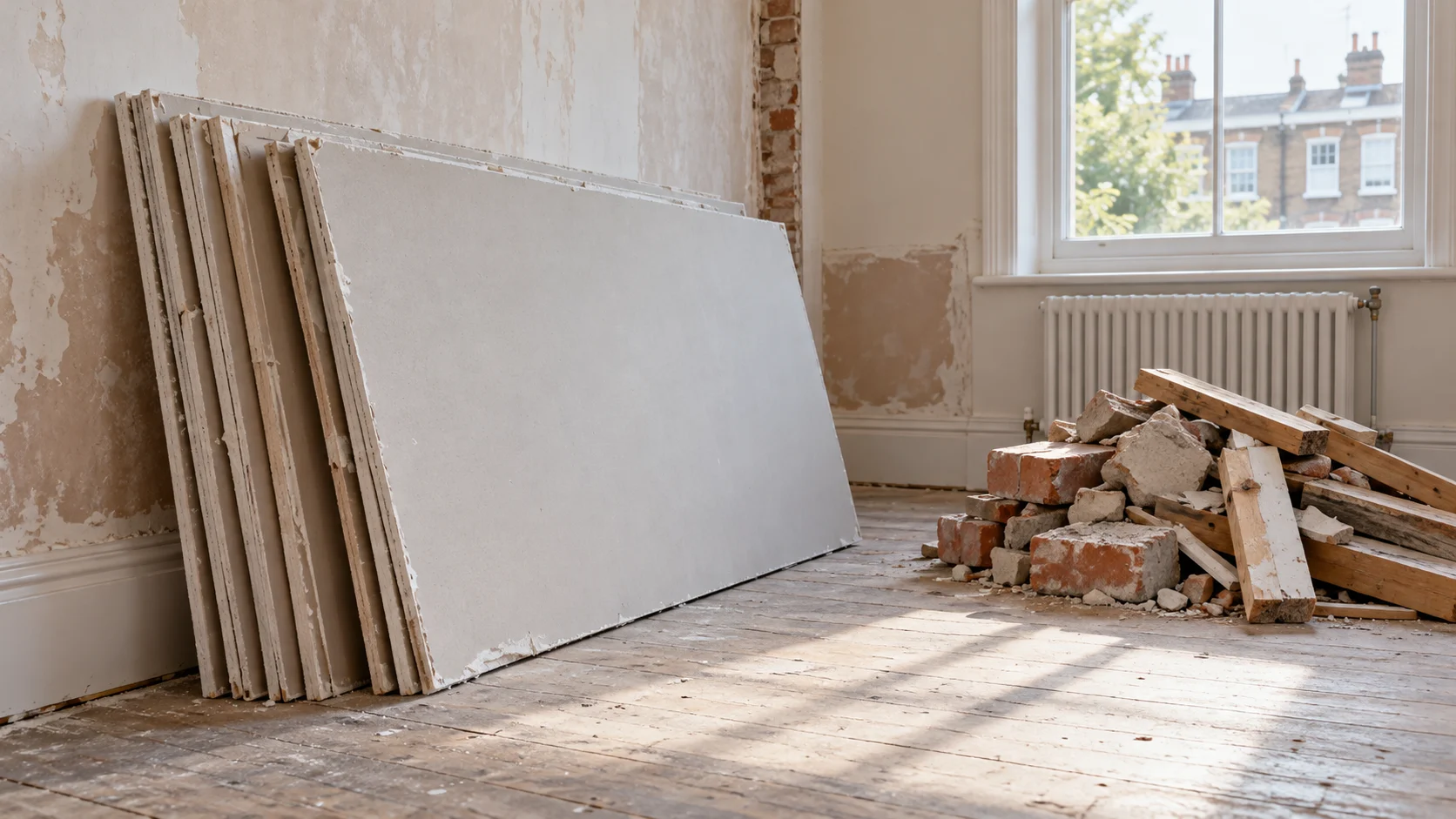
Pulling down a partition or replacing a ceiling can create a mixed pile within minutes. Plasterboard pieces land alongside timber studs, screws, insulation, tiles and ordinary rubbish. It may all look like “building waste” from one job, but plasterboard contains gypsum and needs a separate route. Sorting as the work proceeds is easier than trying to pick dusty fragments out of a mixed skip after the renovation is finished.
This guide concentrates on household plasterboard waste, including offcuts and removed boards. It explains why segregation matters, how to describe the load and what to ask a council site or collector before handing it over. For the wider mix of materials from a project, our builders waste clearance guide is the service starting point; this article addresses the gypsum component in detail. It does not assume that every board can be recycled or that a household centre will take waste produced by a paid contractor.
Understand the gypsum rule before you make a mixed pile
Plasterboard has a gypsum core faced with paper. The North London Waste Authority says it must be separated from other waste because it contains gypsum. Environment Agency landfill guidance says gypsum-based waste such as plasterboard must not go into a landfill cell that accepts biodegradable waste; it should be separated for reuse or recovery first, and any landfill route requires a suitable separate cell. These are controls for the receiving system, but the practical implication starts at the renovation site: keep the boards identifiable and apart from ordinary mixed rubbish.
Why is the distinction important? An Environment Agency position statement explains that gypsum disposed of with biodegradable waste can produce odorous and toxic hydrogen sulphide gas. The point is not that touching a clean plasterboard offcut creates that gas in your room. The concern is inappropriate mixing and conditions at waste facilities. A dedicated stream gives the facility a chance to recover gypsum or use a permitted destination.
Do not rely on a supposed “small percentage” allowance for gypsum mixed into general waste. The older Environment Agency position statement explains that a former 10% working guideline was withdrawn because it could not support a reliable threshold. A few hidden pieces still complicate the receiving load. Ask the waste provider how it wants all plasterboard presented, and keep it separate from the start rather than trying to calculate an informal exception.
Plasterboard is also different from cement render, concrete blocks and broken ceramic tiles. They may all be pale and dusty, but a container labelled “rubble” is not automatically a suitable gypsum container. Bradford Council's plasterboard guidance gives a clear example: gypsum products are excluded from general and rubble skips at its centres and must be handled separately. Check the specific rules for your own London centre rather than copying the exact Bradford procedure.
Set up a separate area before dismantling begins
Choose a dry, accessible spot for intact sheets and larger offcuts. A flat low stack on a protected surface is easier to inspect than a tall leaning bundle that could tip. Keep the route to that stack clear of stairs, doors and electrical work. If boards have nails or screws attached, note them and remove accessible loose fixings safely; do not create sharp hidden edges by snapping around them. A separate rigid container for loose metal parts prevents them from puncturing bags.
Put timber studs, insulation, plastics, tiles and rubble in their own groups as they come off the wall or ceiling. This need not be a complicated set of labelled bins, but every worker should know which pile is for plasterboard. If the job is being done by tradespeople, agree who is responsible for separating and removing each stream before they start. A quote for demolition labour does not always include waste handling, and a quote for one mixed load may conceal a later plasterboard surcharge or refusal.
Keep usable new offcuts separate from demolition fragments. A dry, clean board section of a practical size may be useful in the same project or to another person. Describe its dimensions and condition honestly. A crushed, wet or adhesive-covered scrap is a different proposition. Do not keep every tiny piece merely in the hope that it will be reused; decide what has a real recipient or purpose and place the remainder in the waste stream.
If the building is older and you cannot confidently identify a board or associated material, pause before breaking it further. Plasterboard itself is not a reason to call every wall hazardous, but an unknown ceiling or adjacent insulation may require a separate assessment. Do not mix suspected asbestos-containing material with the plasterboard pile. The HSE asbestos guidance is the place to check obligations and obtain competent help for suspect materials. A normal waste quote should not be used to disguise an unresolved hazardous-material question.
Keep contamination and moisture under control
The cleaner the board stream, the more options the receiving site may have. Remove loose timber, tile, brick and metal where it is safe and reasonable to do so. West Northamptonshire Council gives an example of a centre rule that requires plasterboard to be free of attached wood, tiles and bricks, while accepting some painted, wallpapered or foil-backed boards. Other sites can have different rules. Ask the actual facility or collector about the surface finishes and attachments in your load before you strip or bag anything.
Avoid leaving the pile uncovered in rain. Wet board becomes heavy, soft and harder to handle, and a disintegrated stack is difficult to keep out of the surrounding rubble. Cover it in a way that prevents wind from carrying fragments without trapping standing water against the board. If it is already wet from a leak, tell the collector. Do not hide damp pieces beneath intact dry sheets to make the visible stack look cleaner than it is.
Loose plasterboard dust and small fragments should be contained in bags or a suitable covered container as agreed with the provider. Do not sweep them into drains, a garden pile or the general household bin without checking the waste route. Fill bags to a safe lifting weight; even small pieces can become heavy when damp. A torn bag at the doorstep turns a neatly separated stream back into a mixed mess on the access path.
The same principle applies to plaster removed from a wall. Not every plaster product is gypsum based, and the receiving site may distinguish gypsum plaster from cement-based material. If you cannot identify a dusty mixed bag, say so. It is better to ask for a destination decision than to label the entire load “clean plasterboard” based on the most visible sheets. The heavy waste quote guide also explains why dense bags need a different estimate from bulky light boards.
Measure the load for a truthful collection quote
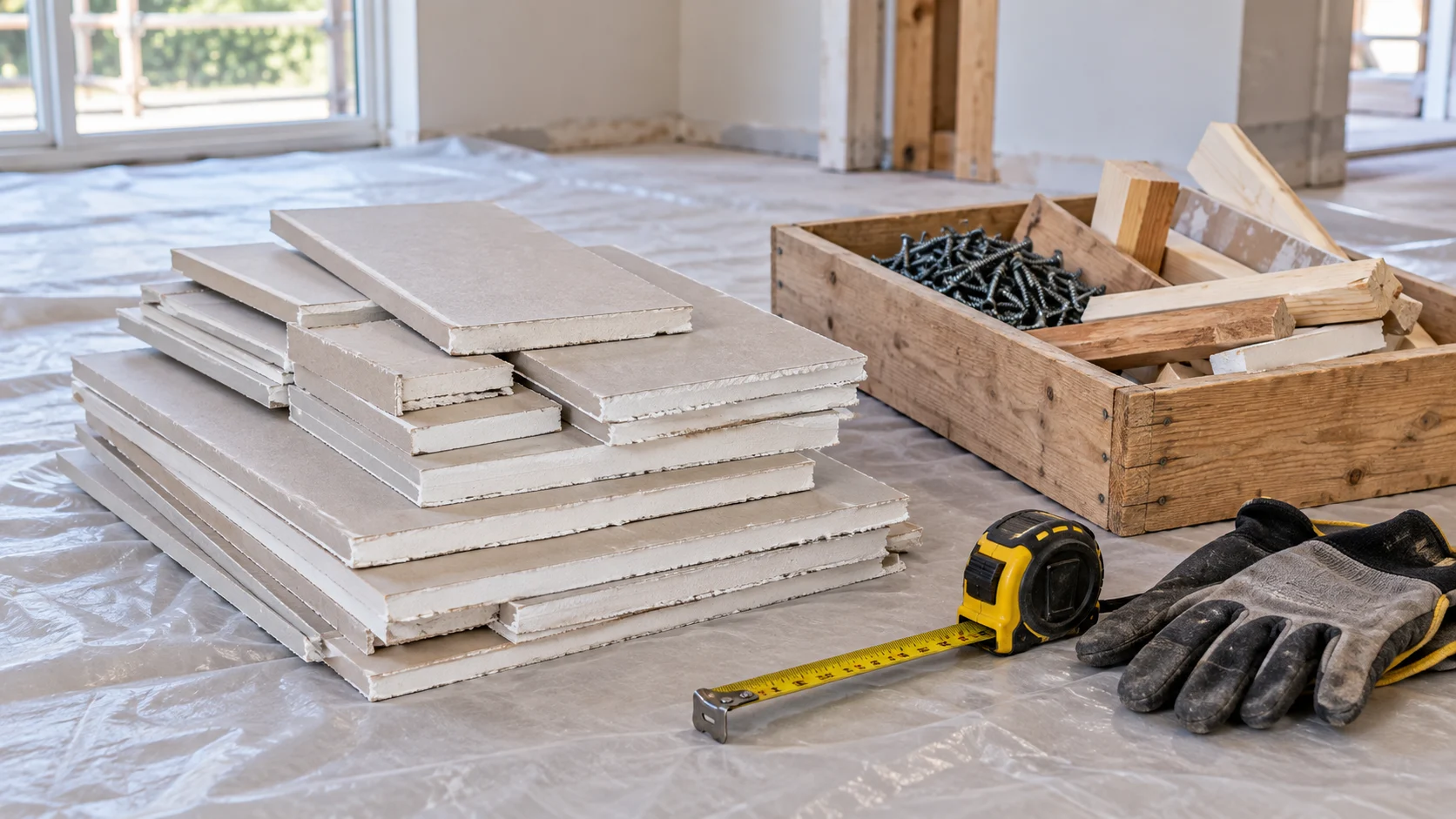
Count full or partial sheets and estimate the sizes of the largest pieces. Give the approximate pile length, width and height for small fragments, and count filled bags separately. Tell the provider whether boards are intact, broken, wet, attached to timber or covered with tile adhesive. A “small bathroom renovation” could mean a few neat offcuts or a stack of damp boards plus insulation and tiles. The room name is not a useful waste measurement.
Photograph the plasterboard pile from far enough back to show its whole extent, then show the exposed edges and any attachments. Photograph the separate timber and rubble groups too so the collector knows the full scope. Our photo guide for an accurate rubbish quote gives a practical sequence of overview, detail and access shots. If the work is unfinished, send an estimate first and update it once the final pile exists.
Describe access: the floor of the property, any stairs or lift, narrow hallway, parking distance and whether pieces must pass through finished rooms. Do not cut up clean sheets simply to fit a doorway without checking whether the collector or reuse recipient prefers them intact. Conversely, if pieces are too large to move safely, agree who will reduce them and how dust will be contained. The shared access guide helps identify access details that affect time and labour.
Ask for a quote that itemises or at least clearly includes the gypsum stream and states what is excluded. If tiles, insulation, timber or general waste are also being collected, list them separately. Our guide to what a removal quote should include explains why scope and loading details matter. The lowest-looking quote can change if it was based on a mixed-load assumption that the receiving facility will not accept.
Check a household centre before loading a vehicle
North London's plasterboard directory lists its reuse and recycling centres as accepting plasterboard and suggests asking a council about bulky collection. It also points to DIY reuse points for material that can still be used. This is helpful if your address is in the North London Waste Authority area, but check the live centre page for opening times, resident proof, vehicle rules, appointment requirements and DIY quantity limits. Other London boroughs use different arrangements.
For example, Southwark Council lists plasterboard among household materials accepted at its centre and tells visitors to separate materials into the correct storage bins. Its page also says waste from business activity cannot be brought as household waste. Your own centre may apply similar distinctions but not identical procedures, so confirm origin and material before a trip.
Do not assume that a free household allowance covers a contractor's renovation waste. If a paid tradesperson removed the board, clarify who produced and controls the waste and whether the proposed centre accepts it. GOV.UK's household waste guidance distinguishes waste generated by tradespeople during work from ordinary household DIY waste. Agree the disposal responsibility in the renovation contract rather than at the recycling centre gate.
If you are hiring a private collector, check that it is legally entitled to carry the waste and ask where the plasterboard will go. A registration check is part of household waste due diligence, but the collector must also have a suitable receiving route for the particular material. Keep the receipt or waste documentation and note whether all the declared gypsum was taken. Do not claim that the board was recycled unless the provider can substantiate that outcome.
Finish with a clean separation check
Before collection, look again at every pile. Are plasterboard offcuts hiding under insulation or timber? Are metal fixings in a box? Are broken pieces contained and dry enough to carry? Have you declared wet or contaminated sheets? A short check at this point can prevent a rejected load, a revised quote or a second visit. Keep a photograph of the final sorted area for the handover.
After the crew leaves, inspect the storage spot for loose gypsum fragments and check that any reusable offcuts you intended to keep have not been loaded. If another phase of renovation will produce more board, set the separation area up again before work resumes. The useful habit is simple: keep gypsum identifiable from the moment it is removed, then match the actual pile to an accepted centre or collection route. For a quote on the separated material and other renovation waste, contact Rubbish Please with the counts, photos and access details.