Warehouse apartment move
Large furniture, boxes and appliances assessed against lift doors, corridors, gates and a managed courtyard loading slot.
Warehouse flats, estates, terraces and creative workspaces
Hackney rubbish removal can involve a goods lift in a converted warehouse, a managed estate courtyard or a narrow Victorian hallway. We match the load to the actual route and keep shared access clear.

Hackney building types
Warehouse conversions may offer generous rooms but controlled gates, internal courtyards and lifts with strict dimensions. Estate blocks can require caretaker contact and a designated loading point. Terraced houses and conversions bring tight halls, basement steps and bicycles or buggies stored along shared routes. The crew needs the whole journey, not just an attractive wide photograph of the room.
Show every item group, then photograph the lift, stairs, doors, gates and vehicle position. State the floor, entry code and who can release a loading gate. Move personal bicycles and loose objects away from the path, but do not stage rubbish in a lobby or beside communal bins unless that space is expressly authorised.
Courtyards and estates
Confirm caretaker, concierge or managing-agent procedures before booking. Provide gate dimensions, codes and the permitted vehicle or loading period. If the vehicle must remain outside a development, measure the route through the courtyard. Lift availability and capacity should be verified rather than assumed from its presence.
Keep fire doors, cycle stores and bin access clear. Large furniture needs dimensions at the narrowest lift door or stair turn. For several rooms in one dwelling, our flat clearance service offers a room-by-room approach and makes retained landlord or housemate items explicit.
Hackney collection scenarios
Large furniture, boxes and appliances assessed against lift doors, corridors, gates and a managed courtyard loading slot.
Named-room contents removed through lifts or stairs while communal landings, bin areas and neighbours’ access remain unobstructed.
Benches, shelving, furniture and accepted equipment separated from paint, solvents, batteries and fixed installations.
Hackney access matrix
| Setting | Typical contents | Route detail | Preparation |
|---|---|---|---|
| Warehouse conversion | Sofa, tables, boxes and appliances | Goods lift, corridor, gate and courtyard | Reserve lift and loading access |
| Estate block | Bags, beds and household furniture | Floor, lift or stairs and designated bay | Confirm caretaker procedure |
| Victorian terrace | Room contents and garden items | Hall turns, steps and side passage | Keep shared bikes and buggies clear |
| Studio or workshop | Shelving, furniture and equipment | Service door and working hours | Separate chemicals, batteries and fixed gear |
Paint, solvents, fuel, gas cylinders, asbestos, clinical waste and unidentified containers are not ordinary general rubbish. Keep them visible and declare them before attendance.
From item groups to loading
Photograph household furniture, electrical items, dense sacks and workshop contents as distinct groups. Count bags and provide dimensions for bulky pieces. State what activity produced commercial material; a sealed tub from a studio cannot be treated as harmless merely because it fits inside a box. Do not open or combine unknown substances.
We assess the accepted load, route and labour and arrange the collection. One authorised contact shows the crew the final scope and receives the quote before loading. Extra items or a changed gate arrangement are reassessed openly. The team removes agreed loose contents, not fixed equipment, building fabric or hazardous material by assumption.
Separate domestic, electrical, workshop and dense materials.
Show lifts, stairs, corridors, courtyard and loading point.
Arrange keys, codes, caretaker and gate permissions.
Confirm the presented load and quote before loading.
Hackney pricing guide
From £55
From £120
From £180
From £240
These are starting guides. The final quote depends on actual volume, weight, material and labour. Floors, lift limits, long courtyards, dismantling, gate procedures and distance from a legal vehicle position can change the work. Any applicable supplementary charge is explained before loading.
Dense renovation waste must be assessed by material and likely weight. Keep rubble, tile, plaster and soil separate from furniture or packaging and use builders clearance for suitable project debris.
Studios and electrical items
Studios and workshops should isolate paints, solvents, aerosols, oils, batteries and pressurised containers. Identify freestanding furniture and equipment that is authorised for removal. Fixed benches, extraction, plumbing and wiring require separate work. Staff should remove confidential or proprietary material before the ordinary collection.
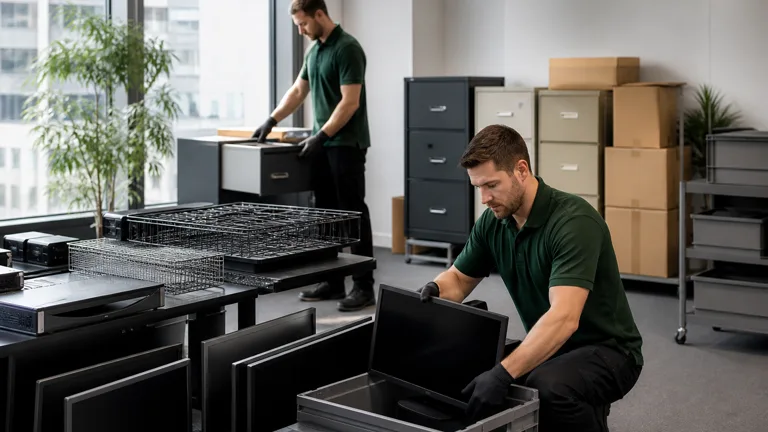
List computers, monitors, printers and other electricals individually. Address data-bearing devices first. Suitable workplace furniture may be planned through office clearance; sofas, wardrobes and domestic tables can use furniture disposal after access dimensions are checked.

Around Hackney
Hackney questions
Yes, when its availability, dimensions, capacity and building rules are confirmed before attendance.
The resident or authorised building contact should follow the estate procedure and provide reliable keys, codes or caretaker access.
Not unless the location and material are lawfully authorised. Keep routes and bin access clear until the agreed collection.
Do not mix them with general waste. Declare chemicals and liquids separately so acceptance and an appropriate route can be checked.
Limited agreed dismantling may be possible after dimensions and construction are reviewed. Fixed fittings are not assumed.
List electrical items separately and remove or securely address confidential data before collection.
Provide the external stopping point and full carrying distance. Labour and feasibility may need to be reassessed.
Open the whole route
Send the grouped load, floor, lift or stair route, courtyard distance and confirmed gate procedure in one brief.