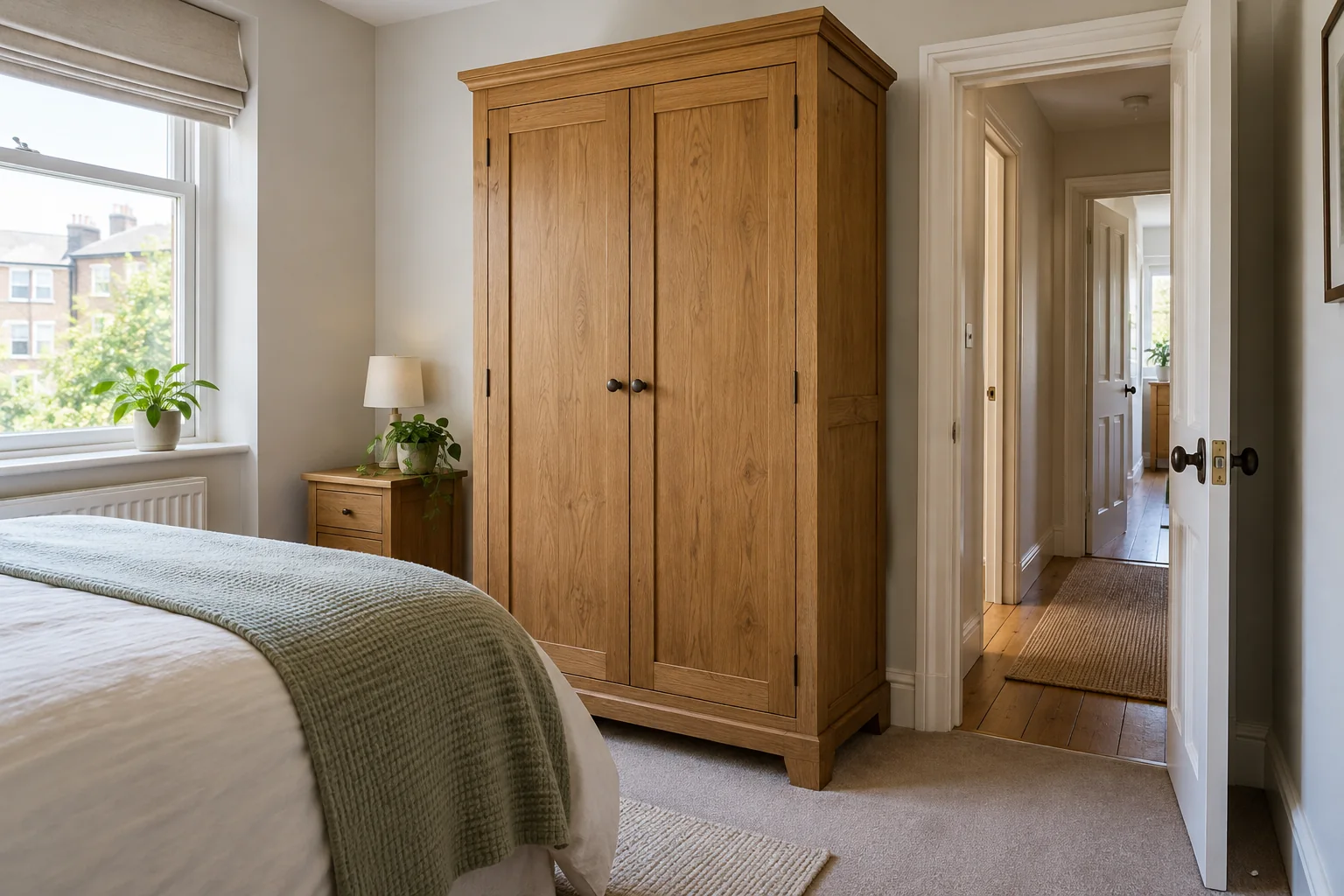
A large wardrobe can be the hardest item to remove from a small flat even when it is nearly empty. Its height makes it awkward to tilt, its depth may exceed the useful doorway width, and a narrow landing can prevent the turn that looked possible from inside the bedroom. Some wardrobes are solid units; others are assembled panels that may not survive a second dismantling. Before anyone carries it, establish what the wardrobe is, where it must travel and whether it is going to be reused or treated as waste.
This guide is specifically about a wardrobe in restricted flat access. It is not a general checklist for every furniture item. A safe plan records the actual measurements, the pieces that can be removed without destabilising the unit, and the work included in the collection quote. It also leaves shared corridors and stairs clear for neighbours throughout the job.
Identify the wardrobe before judging the route
Measure the wardrobe's height, width and depth at its widest points. Include handles, feet, cornices and projecting trim. Record whether the doors are hinged or sliding, whether any panels are mirrored or glazed, and whether it has drawers or a heavy internal shelf. A tall, narrow cabinet can be difficult to control even if its weight seems manageable; a deep cabinet can fail at the first door frame. Photograph the full unit and its sides so the collector can see the shape.
Find out whether the wardrobe is freestanding, anchored to a wall, or built into the room. A bracket preventing tipping is not the same as a fitted cabinet joined to a wall or ceiling. Do not pull a fixed unit away without understanding what supports it and whether it conceals cables or other services. If removal requires detaching fitted joinery, wall repairs or electrical work, explain that before booking a routine waste collection. The right person to detach it may be a tradesperson or the installer rather than the carrying crew.
Empty the wardrobe completely before assessing its movement. Clothes, boxes and items above the top change its weight and centre of gravity. Check drawers and shelf corners for documents, keys and small possessions. Remove loose contents for safety, but do not take structural parts off merely to make a photograph look simpler. A provider needs to see the original assembled item as well as any parts you later remove.
Measure every tight point, not just the bedroom door
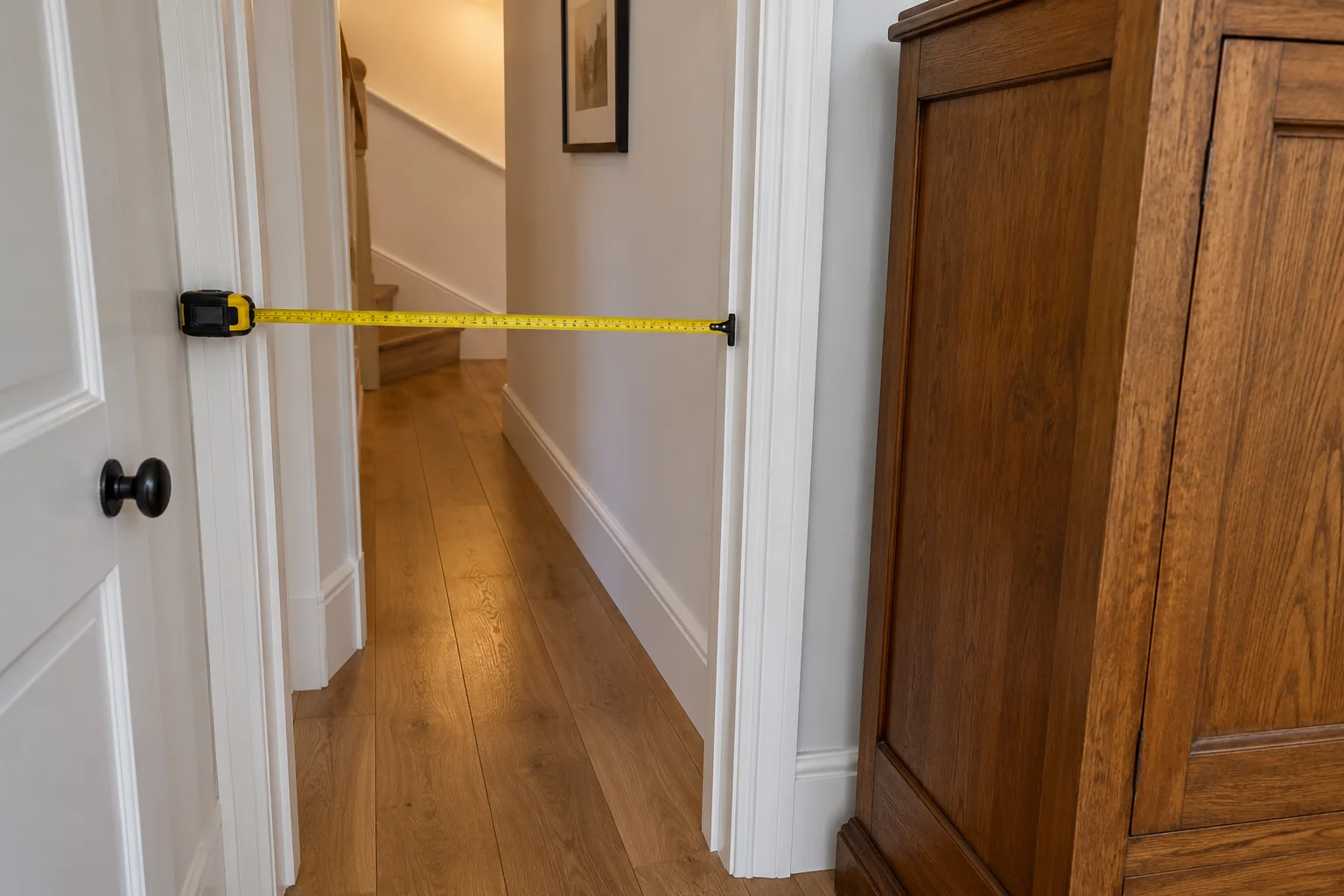
Start at the wardrobe and follow the complete route to the vehicle. Measure the clear opening of the bedroom door with the door in its normal position, then the corridor, any second door, lift entrance, lift interior, stair width, landing and building exit. Note protruding handles, radiators, rails and low ceilings. The useful space is what a carried wardrobe can pass through, not the wall-to-wall dimension on a floor plan.
Pay particular attention to turns. A unit may fit a straight corridor but not rotate at its end. A tall wardrobe might need to be tilted to get through a door, increasing the floor area it occupies. Do not assume that removing a door leaf or handrail is acceptable in a rented or managed building; it may require permission and a safe reinstatement plan. Take wide photographs of each turn and a close photograph of the narrowest point with a tape measure in view.
If the building has a lift, check its usable height and depth, not only the doorway width. A wardrobe that passes the lift threshold may still be too long to stand or angle within the car. Ask the building manager whether furniture moves need a reserved lift, protective covers or a service entrance. Our flat bulky-waste preparation guide covers those shared-building arrangements in more detail.
Decide whether the intact cabinet can move safely
Do not make the decision solely from one dimension. Consider how many people can get a secure grip, where they can stand on the landing, whether the unit can remain stable as it tilts, and whether a mirror or glass door changes the risk. The Health and Safety Executive's manual-handling guidance highlights bulky loads, restricted movement, twisting and stairs as factors that increase strain. A heavy, awkward cabinet in a tight stairwell is a reason to seek a safer method rather than force the turn.
Never try to slide a tall unit along a communal corridor if it could tip onto somebody. Do not carry it where it blocks your view of stair edges. Keep children and neighbours away from the immediate carrying route and use the building's permitted time window. If the route cannot accommodate the intact wardrobe, identify which parts can be removed according to its construction and ask the collection team to assess the resulting pieces.
The wardrobe might have entered the flat as panels and been assembled inside. That is useful evidence, but it does not prove that it can be dismantled again without damage. Particleboard fittings can loosen, glued joints may not separate, and older paint or glass needs careful handling. A realistic plan allows for a professional assessment or a revised quote if the first inspection reveals a different construction from the photographs.
Treat doors, mirrors and panels as separate hazards
Open each door and check how it is attached. Hinged doors may be detachable; sliding doors often run in a top or bottom track and can have heavy glass or mirror panels. Do not remove a door if you cannot support its weight throughout the process or do not know the maker's sequence. Tape across a mirror is not a guarantee that it will be safe to carry. Tell the provider about any cracked or loose glass so it can plan separate protection and handling.
Shelves and drawers are easier to lose than the main carcass. If a recipient will reuse the wardrobe, keep the matching supports, hinges, runners and fittings with it. Photograph the positions before removing anything. The British Heart Foundation's furniture collection guidance gives a missing wardrobe door as an example of a part that affects resale; each reuse organisation still decides what it will accept. Secure small fixings in a labelled bag rather than mixing them into general rubbish.
If the wardrobe is waste, a collector still needs to know every part. A detached mirrored door is not an ordinary wooden board. Sharp edges and projecting screws should not be left exposed where people walk. Ask the team whether it prefers doors, shelves and carcass together or prepared separately. Avoid smashing panels to make them smaller; that creates additional hazards and may make the quoted scope inaccurate.
Keep the reuse option honest
A wardrobe in sound condition may suit a new owner or a furniture charity, but the recipient must accept the size, condition and collection route. Show clear photos of the front, inside, sides and any defects. Give the assembled dimensions and explain if dismantling is required to leave the flat. Ask whether the recipient collects assembled furniture, accepts disassembled panels, or requires the wardrobe to be complete with instructions. Do not promise a reassembled cabinet when its fixings are missing or its panels are damaged.
If the wardrobe is going to waste, check the borough's current bulky-item rules. GOV.UK directs households to their council for local large-item disposal options. The council may specify the item count, placement point, preparation and date. A service that expects the item outside the property will not solve an upper-floor carrying problem unless you arrange that work separately. Do not leave the unit or loose panels in a shared corridor or on a pavement before the authorised collection time.
A household recycling centre may accept the material if you can transport it, but check the site's rules for residency, booking, vehicle type and mixed wood or mirror components. A direct trip is not automatically easier than a booked collection when the most difficult part is getting the wardrobe down from the flat. Consider the whole route and the help available, not just the disposal fee.
Quote the dismantling and carrying as real work
When asking a private team for a price, send dimensions, photographs of the wardrobe and every tight point, the floor level, lift details, approximate distance to the loading place and whether the unit is wall-fixed. State whether you want the team to detach doors or dismantle the carcass, and ask if those tasks are within its service. A basic furniture pickup and an inside-property removal with dismantling are different scopes. Our guide to what a rubbish removal quote should include helps make the comparison clear.
Ask how the price changes if the wardrobe must come apart into more sections than expected. Clarify whether the quote includes carrying, loading, disposal, any wait for access and the removal of small detached pieces. If there is a lift booking or a lawful loading window, give the exact time. The London parking and loading guide explains why the vehicle stop can affect the carrying plan. A long walk from flat to van should not be discovered after the crew arrives.
Check the business carrying waste. The government's waste duty-of-care code advises householders using a private business to check for valid upper-tier waste-carrier registration. Keep its details and the collection record. If the item can be reused, agree that route with the recipient directly; if it is waste, make sure the collector accepts all listed parts, including glass and metal fittings.
Confirm the route on collection day
Before the appointment, empty the wardrobe and clear ordinary obstacles without moving the cabinet into a shared passage. Confirm that the lift, service entrance and loading point are available. Have the photos and measurements ready, and tell the crew if a door, hinge or panel has become loose since the quote. An authorised person should be reachable if a new obstacle requires a decision about dismantling or cost.
For help with a large wardrobe and other bulky items, Rubbish Please furniture disposal is a relevant service starting point. Send the actual dimensions, condition, route and photographs when you request a quote. Whether the final route is reuse, council collection or a registered private team, the important outcome is the same: the wardrobe leaves without an unsafe lift, an obstructed corridor or unaccounted pieces.