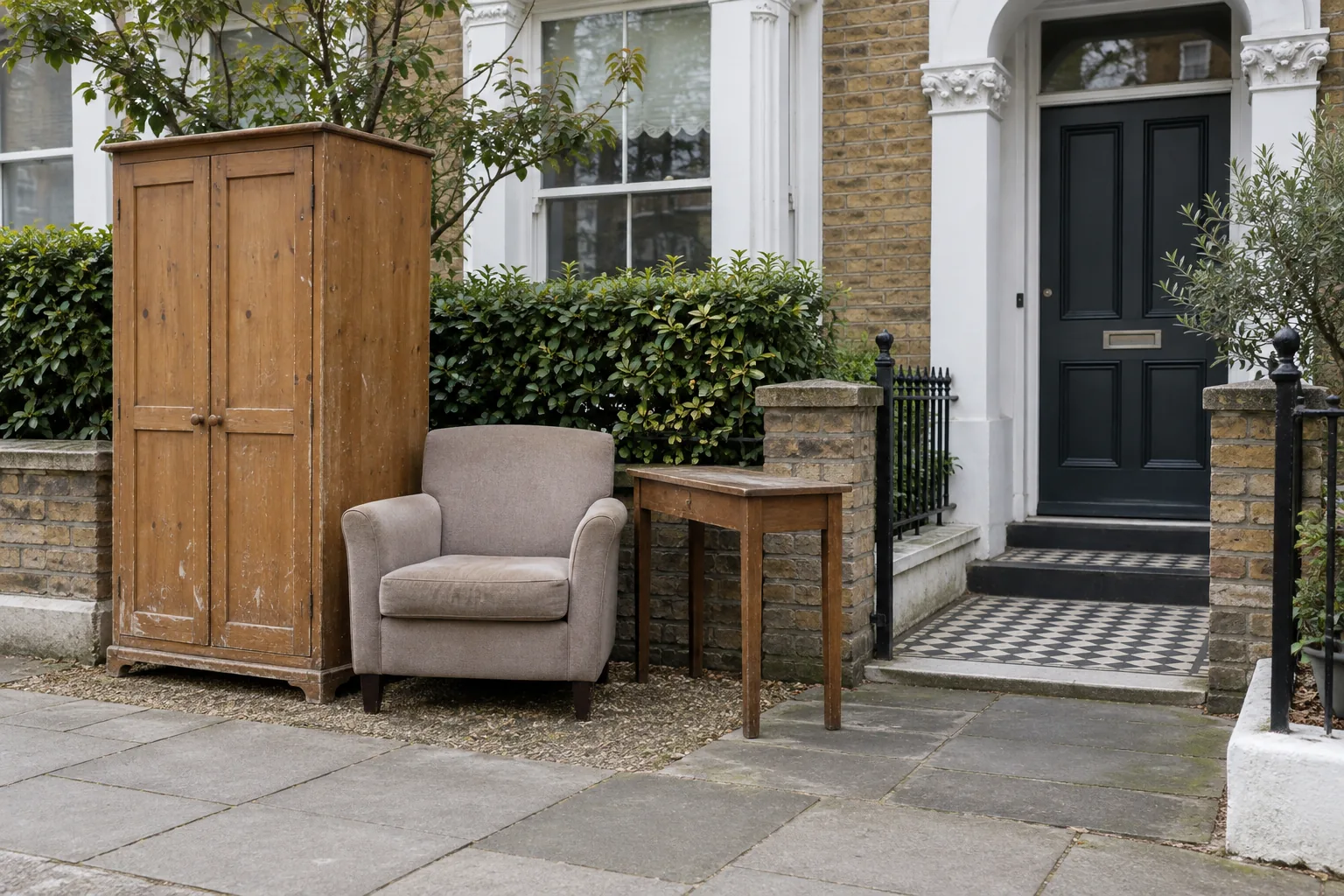
An unwanted wardrobe or sofa presents a practical choice: use your council's bulky item service or arrange a private collection. Both can be legitimate routes, but they may cover different items and expect different preparation. The council might require you to place an accepted item at a specified collection point on a booked date. A private team may be able to quote for carrying several items from inside the property. The details depend on your address, the material and the service you choose.
This guide helps you compare the two routes without assuming that every London borough has the same rules or that a private price is always faster or cheaper. Start with the actual item list, check your council's current booking page, and request a private quote only for the work you need. A decision based on the full scope is more useful than a headline collection charge.
Identify the items before looking at prices
Write down every large item you want gone, with approximate dimensions and condition. “One wardrobe” may mean a light flat-pack unit that can be dismantled or a heavy fitted cabinet that will not pass through the doorway intact. Count separate pieces, including drawers, detached doors and broken parts. If there are bags, small loose objects or renovation materials mixed with the furniture, list those too; a bulky-item scheme may accept only specified large household items.
Take clear photographs of the full items and the route to the collection point. Show stairs, a small lift, narrow turns and the building entrance. State whether the items can be moved safely by the household. Do not place furniture in a shared hallway or on the pavement simply because you are waiting for a collection. Keep access routes clear and follow the actual provider's placement instructions for the confirmed date.
If an item is still useful, consider repair, sale or donation before treating it as waste. A reuse organisation may have its own acceptance and collection criteria, particularly for upholstered furniture or electrical goods. Do not promise an item for reuse until the recipient confirms it can take it. When an item is damaged or unsuitable, describe the condition honestly so the waste collection quote matches the real job.
Check your council's current bulky collection rules
GOV.UK says councils may offer special collections for large household items, and directs residents to their own council for the available services. Find the page for your exact borough or district. Check which items are accepted, how many can be booked together, the charge, the available dates, and the deadline for changes or cancellation. The local rules can differ even across neighbouring London addresses.
Pay close attention to the handover point. Some council services require items outside the property by a stated time, while others give different instructions for flats or estates. Check whether the service carries from inside; do not assume that booking a collection includes stairs or dismantling. Ask what to do if you cannot safely move the item to the requested point. For a building with communal space, check the managing agent's rules as well as the council's instructions.
Read the exclusions rather than guessing from the label “bulky waste”. A council may treat electrical appliances, upholstered furniture, large glass, building debris or garden material differently. The booking form may count sections of an item separately. If an item is not listed, contact the council before paying. A missed or refused collection can leave the same storage and access problem you were trying to solve.
Consider the date and how long the item can stay
Timing can decide the route. If you are clearing a rental before a handover or need a room available for builders, check the first council slot before making plans around it. Some dates may be convenient and others may not fit your deadline. A private provider can quote its own availability, but that does not guarantee a particular slot until the booking is confirmed. Compare actual available dates, not general claims of speed.
Plan where the item will remain until the collection. A sofa in a vacant room may be manageable for another week; a large cabinet blocking a safe exit is a different matter. Do not move bulky items outside early and expose them to weather or create an obstruction. If the council asks for placement on collection morning, ensure somebody can do it safely at the required time. If you need help moving the item, include that labour in the decision rather than leaving it as an afterthought.
If several items will become available over different days, one coordinated private clearance may reduce repeat bookings, but only if the complete load is known and the timing works. Conversely, a single accepted item that you can place at the council's requested point may be simple to book through the local service. The best timing is the one that leaves the property safe and the agreed scope ready when the collector arrives.
Understand what a private team would do
A private collection can be useful when the work involves carrying furniture from upstairs, dismantling a large item, removing several categories of waste or clearing more than one room. Ask for a written quote based on an item list, photos and access details. Check whether the crew will carry from inside, how many trips are included, and whether it will bag or handle smaller waste. Our guide to what a rubbish removal quote should include gives a fuller checklist.
Do not assume every private service accepts every item. Describe appliances, glass, damaged upholstery and unusual materials before accepting the price. If the object is too large to pass through a doorway, ask whether safe dismantling is included and whether the work is within the team's service. If a fitted unit must be detached from a wall or plumbing, that is different from carrying away a freestanding cupboard and may require a tradesperson first.
The collection location matters. A ground-floor item beside a legal loading point is less work than the same item on the fourth floor without a lift. Show shared hallways and parking restrictions. A quote that assumes kerbside pickup cannot be compared fairly with one that includes two people carrying items from rooms. If the load changes, send revised photos before the appointment and agree any adjustment before extra work begins.
Compare the complete cost and responsibilities
Put the two options side by side. For the council, record its charge, number and type of items, first suitable slot, placement point and preparation requirements. For a private provider, record the quoted total, included items, carrying or dismantling, access, disposal and the conditions for a revised amount. Add any work or help you would have to arrange yourself. A seemingly lower council fee can be less useful if you cannot move a heavy item to its collection point safely.
That does not mean a private team is always necessary. When the council accepts the item, the date suits you and you can meet its placement rules, it may be the straightforward choice. If the load spans furniture, bags and other materials, or the carrying route is difficult, a private quote may cover the whole job more clearly. Avoid universal price comparisons because council charges and private scopes vary by location and by job.
Check whether the private provider is a registered waste carrier. GOV.UK says householders must check the registration of a business taking their waste. Keep the collector's details and the collection paperwork. If you use the council's service, keep its booking confirmation and follow its own rules. Either way, remove only the items included in the confirmed arrangement.
Think through three typical situations
For one freestanding chair and a small table on the ground floor, the council's accepted-item list and first available date may settle the matter quickly. If it will take both pieces and you can put them at its requested point, the booking can be simple. Check whether the two pieces count as two items and whether the table needs any preparation. A private quote remains an option, but it should be compared with the council's actual terms, not with an imagined service.
For a heavy wardrobe in an upper-floor flat, carrying may be the decisive issue. If the council requires outside placement and nobody can safely move it, request a private quote that explicitly includes the stairs, number of people and any dismantling. Photograph the wardrobe, doors, stair turns and vehicle route. Confirm whether a building manager must approve use of a lift or shared corridor. A cheap collection that starts only at the pavement does not solve the carrying problem.
For a room containing a sofa, shelves, six bags and loose timber, check what the council will accept as bulky items and what would remain. Several separate council bookings or a trip to a recycling centre may be practical for some households. A private team might quote for the whole described load in one visit. Ask each option to account for every item and the labour you can or cannot do. Our furniture disposal service and broader waste removal service cover different starting points for that conversation.
Book the route that matches the real job
Make a final list and take wide, honest photographs. Check the council's current accepted items, collection point, charge and date for your address. If the rules or timing do not suit the job, request a private quote that names the carrying work, materials and access. Keep the booking confirmation, and update the provider if the load changes. The decision should leave no unexplained item, unsafe lifting task or uncertain placement point.
If you want help with several pieces or with moving a bulky item from inside the property, contact Rubbish Please with the list, photos and route details. If your local council offers an accepted collection that you can prepare safely on its date, use its current instructions. Both routes work best when the items, responsibilities and timing are clear before collection day.