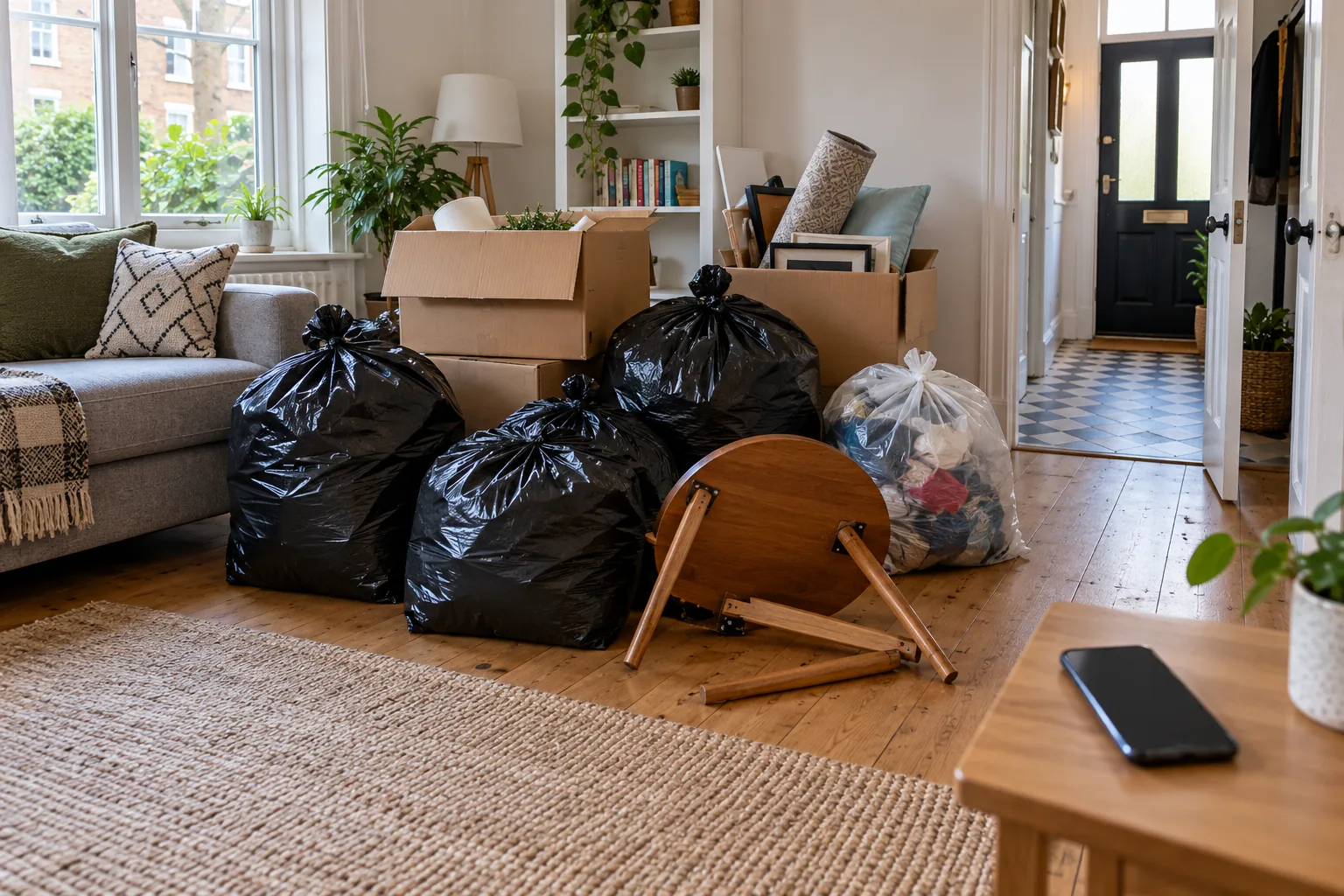
Photographs can make a rubbish-removal quote much more useful, but only when they show the whole job. A close-up of a sofa tells a collector little about the bags behind it, the stairs it must come down or where a vehicle can stop. A clear set of wide views, detail shots and access photos helps the provider assess the material, volume, weight and labour before the visit. It also helps you compare quotes that describe the same work.
You do not need special equipment. A phone camera, daylight and a short item list are enough. The key is to photograph the load after you have decided what is leaving, then capture the route from those items to the vehicle. This guide gives a practical shot list without asking you to move heavy or hazardous material merely for a picture.
Decide what the quote should include first
Mark the items that will stay, go to a reuse recipient or be collected by someone else. If those decisions are unfinished, tell the provider which parts of the photographs are uncertain. A picture of a crowded room can overstate the load when most furniture will remain. Conversely, a neat pile near the door can understate the work if the team must also empty a loft or carry bulky items from upstairs.
Write one line per room: number of bags or boxes, large objects and any unusual material. Take photographs only after this list is reasonably settled. If you later add or remove a substantial item, send an updated picture before accepting the final collection arrangement. A quote cannot be reliable when the load shown no longer matches the load on the day.
Keep personal documents, medicines, keys and valuables out of the removal area. Photographing the waste should not expose private information in the background. If a document or label is visible, move it away from the scene rather than sharing its details unnecessarily.
Start with a wide view of every area
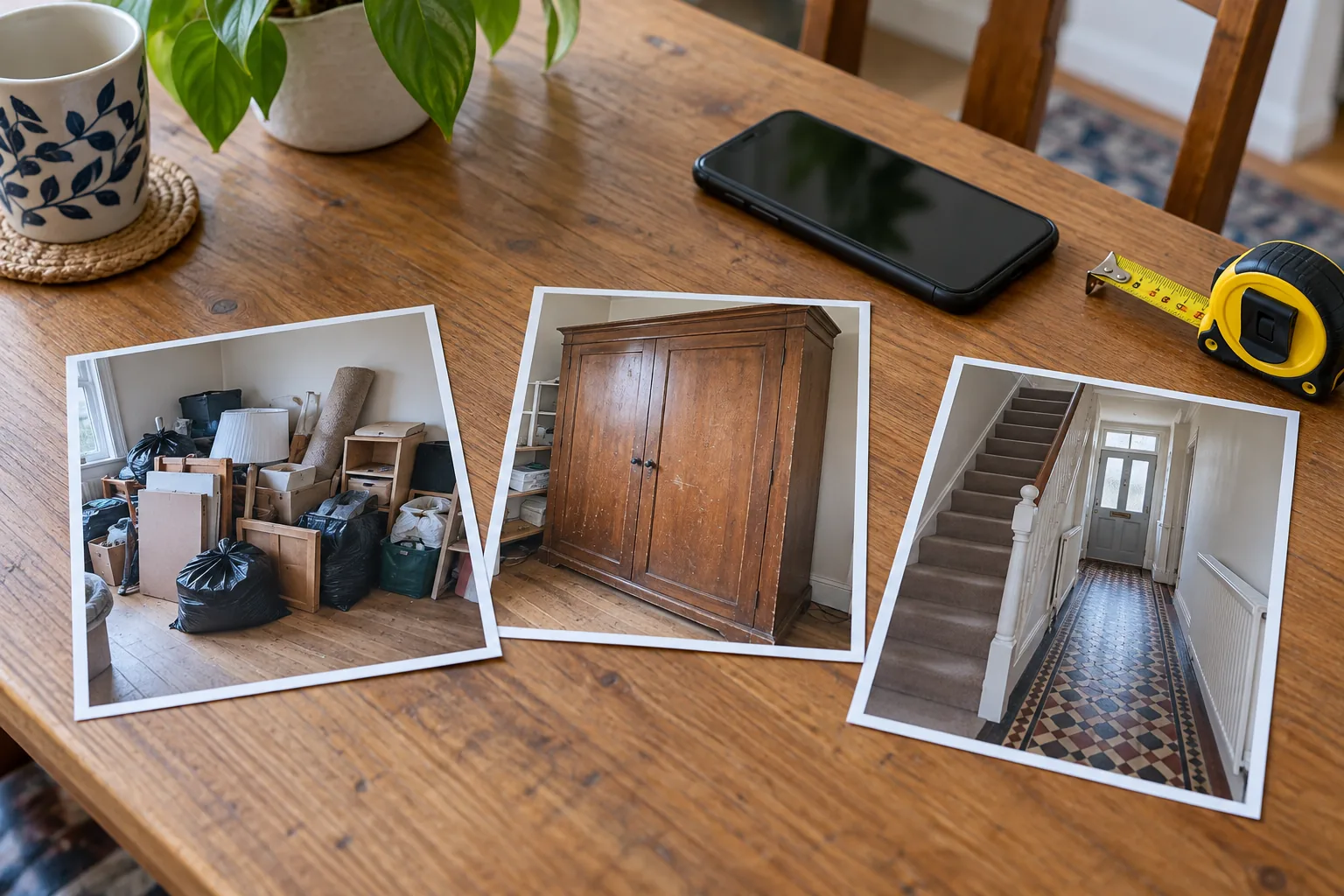
Stand back far enough to show the full pile and the boundaries of the room. A doorway view is often useful. Take an additional angle if furniture hides bags or if a shed, garden or garage has material behind a large object. Do not use a panoramic image that bends the apparent size of the load; two ordinary photographs are usually clearer.
Capture every location that the crew is expected to visit. A quote for “one room” cannot cover bags in a hallway, furniture in a bedroom and broken timber in a rear garden unless those are shown or described. If the property has a loft, basement or outbuilding, photograph its entrance and contents separately. The collector needs to know where the material is, not only what it looks like.
Avoid taking pictures after dark if shadows make the quantity unclear. Turn on the room lights and use a second angle rather than relying on a harsh flash that hides details. If the load is behind a closed door or under a sheet, expose enough of it to show the actual material safely. Do not open an unknown container merely to make a photograph more informative.
Add scale without moving the load
A pile can look small in a close-up or enormous in a low-angle picture. Include something of known size, such as a standard doorway, a chair or an ordinary bin, in one wide frame. You can also provide approximate dimensions: length, width and height of a grouped pile, or the number of bags and boxes. The goal is not laboratory precision; it is to help the provider judge the vehicle space and carrying work.
Count bulky pieces separately. “One two-seater sofa, one narrow wardrobe and six medium bags” is more useful than “some furniture”. For a large cabinet, show its full height and width. If a sofa separates into sections, photograph each section or explain how it comes apart. If a large item cannot be dismantled, say so rather than assuming a team will be able to take it through the door.
Do not stack items into an unstable tower for a single frame. Keep the pile safe and photograph it from two sides. Do not carry heavy furniture down stairs or outside solely to make the quote photographs look tidy.
Show materials that affect handling
Take close-ups of dense or unusual material: books, tiles, rubble, soil, timber, plasterboard, metal, glass or electrical equipment. A van-load estimate based on space alone can be misleading when the load is particularly heavy. Bags of leaves and bags of broken tiles can occupy similar volume but require very different handling. Tell the provider what is inside sealed bags if the photograph cannot show it.
Separate restricted or hazardous materials from ordinary waste. Paint, chemicals, fuels, gas cylinders, asbestos-containing material, sharps and unidentified containers should not be hidden in the general pile. Photograph labels from a safe distance where they are already visible, and ask about the correct route. Do not open, pour, mix or disturb a substance to improve the picture.
Show the condition of large furniture and appliances. A collector may need to know if a cabinet has broken glass, a sofa is waterlogged or an appliance leaks. Include a close-up and a short note. If the item is potentially suitable for reuse, state its condition honestly and arrange any donation separately rather than assuming the waste provider will find a recipient.
Photograph the route out of the property
The carrying route is part of the job. Take a picture of the room doorway, corridor, stair or lift, building entrance and any narrow turn. Show the number of flights, low ceilings, steep steps or long path across a garden or courtyard. If furniture must pass through a shared hallway, explain the building's access rules and any lift booking.
For a large item, measure the narrowest doorway and the item. A photograph of a tight corner helps, but dimensions can settle whether the object fits without guessing. If the provider is expected to dismantle furniture or carry it from upstairs, say so explicitly. Otherwise a quote may assume the load is already at ground level or outside.
Do not block a fire exit or communal route while taking pictures. Keep the items where they are safe until the agreed collection time. The purpose of access photographs is to plan the movement, not to stage the movement early.
Include the vehicle loading point
Photograph the street or service bay where a vehicle could legally stop, including the path from the building entrance. Do not photograph a neighbour's private vehicle registration or home unnecessarily. Tell the provider about controlled parking, loading restrictions, a gate code or a building manager who must approve access. If the closest legal stop is farther away than the front door suggests, that distance matters to the quote.
Check the actual signs and rules for the proposed collection time. Do not promise a bay you cannot reserve. A collector may be able to suggest a suitable arrival window once it understands the route. A street-level photograph alone cannot prove parking permission, so add a brief written note about what you have confirmed.
If the load must cross a shared outdoor area, show that route too. A rear garden reached only through the house is different from one with a direct gate. A flat with a lift and a distant loading bay is different from one where the vehicle stops outside the lift lobby.
Send a compact, ordered set of images
Choose the clearest pictures instead of sending dozens of near-identical frames. One or two wide views per area, close-ups of important materials, and several access photographs often explain the job. Give files simple names or order them in your message: living room, bedroom, garden, stairs, entrance, loading point. Add the short item list and mention anything the pictures cannot show, such as the weight of bagged books or a broken lift.
Our waste removal service covers general collection, and house clearance may be relevant for a larger property-wide load. The price guide gives indicative load sizes, but the actual quote depends on the material and access you describe. Do not compare two providers' prices until both have seen the same scope and exclusions.
If the load changes after you send photographs, update the provider. A new wardrobe, several heavy bags or a different loading point can change the work. Clarify whether the quote includes carrying, dismantling, bagging, transport and disposal. Keep the written agreement and collection receipt. GOV.UK advises checking that a private business taking household waste is an authorised waste carrier.
When you have the wide views, detail shots, access route and item list, contact Rubbish Please for an estimate. A few accurate photographs let the team discuss the real job and help you avoid surprises when the vehicle arrives.